Roommates, Student Life

I Hate My Roommate: What To Do When Your Relationship With Your Roommate Goes Wrong

More often than not, you’ll find yourself in a disagreement with your roommate. While not every disagreement will end in a full-blown fight, there may be times when it will.  The only thing you can do is to prepare yourself for those times and to be ready for anything.

For example, say your roommate has been having their significant other over to your place too much.  When you go to talk to them about it, they get defensive and the issue never gets resolved.  Let’s say that after that point it gets very awkward around your place and you end up leaving each other notes, ignoring one another, and/or just not speaking.  What would you have to do?

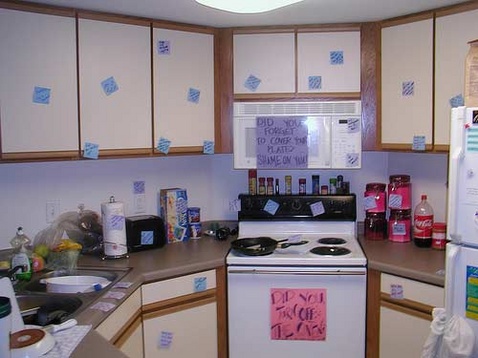
In every case, you should always try to talk with your roommate again.  Avoid leaving passive aggressive notes for one another (you can see why that might not work on www.passiveaggressivenotes.com) and giving them the silent treatment.  It’s time to act like adults; you’re in college (or maybe out of college, depending on who’s reading this).  Take some time and plan out what you’re going to say to them.  Focus on how their actions make you feel and avoid making it about defects in their personality.

You also want to be sure to talk to them when you are calm and levelheaded; they won’t listen to you if you scream at them.  Be sure to detail your feelings, but also be sure to listen to what they have to say.  No matter what, try hard not to take things too personally or become too defensive; this only makes matters worse.  Instead, try to think logically about what they have to say; this means being able to criticize yourself.  What could you be doing to upset them?

If talking with them doesn’t seem to work and it only seems to make things worse, the only thing you can really do from there is to be civil to one another.  Maintain your consideration and respect for one another.  Being roommates doesn’t necessarily mean you have to be friends, or that you even have to like each other; just as long as you respect one another and are considerate, your relationship (or lack-there-of) can work.

While fighting with your roommate can be traumatic, it happens to a lot of people.  The only thing you can do is prepare yourself for those scenarios when it doesn’t work, and sometimes you do just have to concede that you don’t see eye-to-eye or that you just don’t get along.  Although it stinks when you and your roommate don’t get along, it is better that you both can at least come to an understanding and share mutual respect for one another and your space.

Standard
JumpOffCampus

The JumpOffCampus Caffeine Challenge

This week we’re moving into a new office with many of the other Betaspring alums and we’re super excited!  Despite our excitement, however, we are running into a dilemma:  What on earth are we going to stock the new fridge with?  As startups, we’ve got to make sure that we stay alert and productive for over 8 hours a day and we admittedly need a little help.

Therefore, to really test what will be our caffeine of choice, we’ve decided to make this a challenge; a battle of the caffeine, if you will.  To get everyone’s opinion, we’ll be recruiting the other companies we’ll be sharing office space with to see what will be the best choice.

Every beverage (or caffeine product) we test will be designated to one day, so our competitors can’t have any other caffeine product that day.  They will also be given a specific amount they can drink, and will not be able to drink any more than that.  Then, throughout the day, competitors will be surveyed to see how tired they feel, how alert they feel, how productive they feel, and how well they feel they’ve been able to concentrate.  These surveys will happen 4 times throughout the day; once when they arrive at work, once at 11 am, again at 2 pm, and then again at 5 pm.  We’ll be sure to track everyone’s progress as they go throughout the day and see which caffeine beverage seems to be working the best.  We’ll also be asking our competitors to track their progress throughout the day on Twitter.  Each competitor will be tweeting to the hashtag #CaffeineChallenge to update us on the latest.

While we’ll be spending most of the week pretty caffeinated (hopefully), next Friday will be our control day, meaning that we won’t be drinking any caffeine.  This means that we will have been caffeinating all week, and will cut ourselves off on Friday . . . the day of the week it could be the toughest to get through.  It’s on this day we’ll be holding a competition to see which competitor will crack first; either a) cave in and drink some caffeine, or b) fall asleep.

So be sure to follow our progress on our Twitter, and feel free to take the challenge with us!  Just be sure to track your status along with us at #CaffeineChallenge!  We’ll be announcing the competitors tomorrow and the schedule this Friday, so stay tuned!

Your participation in this Caffeine Challenge is strictly voluntary and is not recommended for those who may experience complications due to high caffeine intake. Please see FDA and brand warnings related to consumption of these types of products.
Standard
Roommates, Student Life

Two’s Company & Three’s A Crowd: How to Manage Your Relationship with Your Boyfriend/Girlfriend and Your Roommate

While having your boyfriend or girlfriend around all the time might be great for you, it might not be for your roommate.  Whether you’re living in a dorm or you’re living in an apartment, it doesn’t matter: Sharing space with your roommate and your significant other can get tough to manage.  That’s why we’ve put a list together of all the things you can do to prevent a huge blow up between you, your roommate and your boyfriend/girlfriend.

In an article by Annie Maguire at College Cures, the first thing you want to do is set time boundaries.  This means that you should talk with your roommate about their schedule and when would be the best time for your boyfriend/girlfriend to come over.  You can also work with them to determine a cut-off time (10 pm, 11pm, etc.) for guests, and then stick to your guns.  Once it gets to the cut-off time, your boyfriend/girlfriend needs to go home and so should theirs.

The next thing Maguire suggests is setting spatial boundaries.  This means that you should establish with your roommate where your significant other can spend time in your room/apartment.  This means that you should establish with them (beforehand) where your boyfriend/girlfriend can hang out and what items they can use.

Another rule of thumb when it comes to managing these types of relationships is giving one another space.  This includes giving yourself, your roommate, and your significant other the space they need.  You should be sure that you and your significant other aren’t always hanging out in your room, and that you share time between each other’s places equally.  This way your roommate and their roommate get time alone too.

The most important concerns you should have when it comes to managing your relationship with your roommate and your significant other is to be considerate and to communicate with one another.  You and your significant others’ wants and needs are not superior to your roommate’s and vice versa.  The best way to manage this is to speak with one another frequently and often about what each other needs, wants, and feels about the situation and what each of you can do to make sure everyone is happy.

Standard
Housing Advice, Roommates

What Happens When You Get a New Roommate?

It happens all the time:  You choose to live in the same apartment for another year, your roommate moves on, and you end up with a new roommate.  While it is just a part of life, it’s always a little weird adding a new roommate to the mix, especially if you have been living there already.  This is why we’ve put together some suggestions to help you navigate your new roommate situation.

Don’t forget that it’s their place too.  This is perhaps the most important thing to remember:  If you’re adding a new roommate to the mix, you can’t forget that the apartment is just as much theirs as it is yours.  Just because you have been living there longer doesn’t give you the upper hand.

Take time to get to know them a little.  We’re not saying you have to be best friends, but it is considerate to try to get to know them a little bit.  In particular, you should consider asking them questions about their lifestyle preferences (i.e. when they go to bed, where they like to study, etc.).  That way you know what they like and what they don’t.

Take time to explain to them your existing house rules.  If you and your roommate(s) had previously established house rules (i.e. guest policy, chore distribution, etc.), you want to let them know.  However, because this person is new to the situation, you shouldn’t consider these rules to be set in stone.  Talk with your new roomie about how they feel about the rules you’ve established, what they like (or dislike) about them, and how the house rules can accommodate everyone’s preferences.

Give them a tour.  Show your new roomie where things are normally kept; this includes where the cleaning supplies are, where everyone puts their food, and where they can find extra toilet paper and paper towels.

Be helpful.  Be open to answering any questions your new roomie might have about your place.  Also be sure to explain to them any weird features or problems you may have with the apartment.  This way they know the kooky characteristics of your pad just as much as you do.

While it may be strange for you when your new roomie moves in, imagine how weird it must be for them!  They are moving into a new place with people who have already been there before.  They may think you and your other roommates will be best friends already and/or you will already be into your own routine that you won’t acknowledge them.  This is why it’s important to talk to your new roomie and figure out ways you can help them make your apartment feel like their home too.

Standard
Housing Advice, Student Life

96 square feet?!? What is a college student to do?

Especially as a freshman, it is hard to know exactly what to expect when you’re moving into the dorms.  This is perhaps not only the first time you’re moving away from home, but it is also the first time you are living with someone else. The first thing you will most likely consider is space; especially when you’re living with one, two, or even three other people, you will want to know just how much space will you have and how you will carve out a space that is all your own.

To find out exactly how much space students are given in their dorm room as freshmen, we recently conducted some research across 50 universities around the U.S.  What we found was that the average square footage universities provide per student is around 96 square feet.  That’s pretty small, given that the average mattress size for a dorm room (an extra long twin) is about 20 square feet.  However, perhaps what is most surprising is that, overall, square footage per student ranged from 132 square feet at East Central University in Ada, Oklahoma to 50 square feet at Oklahoma City University.

You’re probably asking yourself, why would they give students so little space?  Well, let’s be honest here:  No school sets out thinking that they want their students to be crammed together like sardines.  Actually, many schools would rather that their students have a lot of space to live and to study within their dorm rooms.  It just works out that, in many cases, they just don’t have the room for it.  Especially if housing facilities are limited, universities can’t provide as much space as both they and their students would hope for.

So what can you do with the little space that you’re given?  We spoke with interior decorator and owner of Fresh Ideas by Sandy, Sandy Alger, about how students can better maximize the space they’re given and make it their own.

The first thing Sandy  suggests is maximizing storage space.  “I suggest using built-ins and shelving on the walls whenever you can.  Under the bed is great storage for the change of season, bedding, etc.”  She also suggests putting extra shelving in the bathroom (that is if you have your own bathroom), so that you can store more items.  By maximizing storage space, you can limit the clutter and mess you would have to deal with if you didn’t have a place to put everything.

Another suggestion Sandy has for students is multi-purposing furniture; she explains that you can turn kitchen tables into desks and coffee tables into storage.  If you have the opportunity to bring items like this, it is a great way to make your dorm room more like home and much more functional.

Alger also suggests bringing only the essentials with you.  Sandy says she lives by the saying, “Less is more,” and urges students to keep it “simple and inexpensive . . . think out of the box.”  She suggests browsing IKEA, and even thrift stores, for pieces and inspiration; photos, magazine prints and even your own artwork can serve as accents and make your room a little bit more “homey.”

However, the most important piece of advice Sandy gives to students is to be themselves when it comes to design.  “Have fun and don’t take yourself too seriously.”  When it comes to making the space your own, you want to be able to express yourself and feel comfortable where you are; you want to be able to feel like you live there, and that this is a place (no matter how small) that you can call your home.

Standard
JumpOffCampus

We need your help!

We’re currently working on some research in relation to student perceptions of on- vs. off-campus housing and we need your help!  If you are a current student, or even if you have graduated within the last two years, you can help us out by taking our survey!  It only takes about 10 to 15 minutes to complete, so if you have some extra time, we’d really appreciate you taking our survey.  Just click HERE to take the survey and feel free to pass this along to your friends!  This survey is completely anonymous, so that means we can’t trace back answers to you, nor will we publish or share who you are.

If you want a direct link to our survey to post on your Facebook or Twitter, just copy and paste this link onto your profile and this will take anyone who clicks it directly to the survey page:  https://docs.google.com/spreadsheet/viewform?formkey=dGJqMjBHZjIyRGluNDlkbllsUFVQRlE6MQ#gid=0

Standard
Roommates, Student Life

The Passive Aggressive Note: What Does it ACTUALLY Mean?

Have you ever had a roommate that would leave you notes when you left dirty dishes in the sink, forgot to clean up your things off the kitchen table, or you had your friend over until 5 am?  Have you ever been that roommate?  If you’ve ever been in that situation (no matter what role you played), in most cases, in never ends well.  This is because there is a lot more behind that note than you may initially think.

Passive aggressive notes could mean one of two things:

The person doesn’t feel like they can talk to you.  Maybe you give that aura of “Don’t mess with me,” or maybe they’ve just never experienced a problem with a roommate before and they don’t know what to do.  The person could also just be afraid of confrontation, and this is their alternative to actually confronting you about the problem.

You aren’t around for them to yell at, so they leave you a note instead.  If someone is extremely frustrated, and you aren’t around, they may take out their frustration in note form.  It’s not the best option, but it certainly happens.

Sometimes it’s easy to see which option it is, especially when you know the person well, but then sometimes it isn’t.  You need to think about what motivations they might have for writing a note like that and what might have you done to make them do that.  You should go speak with your roommate about the note, because you don’t want to let things like this make the relationship worse.  I say worse, because, let’s face it:  your relationship is already not on the best of terms if you’re writing passive aggressive notes to one another.

Here are some tips for talking with your roommate about their passive aggressive notes:

Think about what you’re going to say before you talk to them.  Like we said in our previous posts about roommate relationships and conflict, it’s best to go into a situation prepared.  You want to plan out what you want to say and how you will say it.

Avoid escalating the situation.  You never want to avoid talking things out with your roommate, but you certainly want to avoid escalating the situation.  Avoid directly placing the blame on them, and use “I” statements instead of “you” statements.  This means that instead of saying “I hate it when you leave nasty notes like that for me,” you say, “It bothers me to read notes instead of actually talking with you.”

Act calmly and rationally.   Perhaps the worst thing you can do is to lash out and make accusations or make unrelated arguments about other things the person has done to frustrate you.  Remember:  You need to act instead of react.  This means that you should act on the situation, i.e. talk with your roommate about your relationship, why they are leaving you notes, and what you can do to fix it.  You don’t want to react to their note, meaning that you don’t want to go with your automatic and “gut” reaction to how that note made you feel.  While both you and your roommates feelings are important and should be acknowledged, you don’t want to take out those feelings on your roommate.

Perhaps the overall moral of the story is to be considerate and to have open communication between you and your roommate.  It will be significantly more successful, and significantly more valuable, for you to talk with them instead of resorting to notes, because your reaction (or their reaction if you’re the offender) says it all.  Don’t write passive aggressive notes to your roommates.

Standard
Housing Advice, Roommates

Roommate Sharing 101

If you’ve never lived with a roommate before, it can be slightly daunting.  It’s strange to think that you’ll be sharing a home with someone whom you may have never met before.  There is certainly a lot to navigate when it comes to understanding how you will share that space and the things in it.  This is why we’ve come up with some ideas on how you can make sharing with your new roommate(s) easy.

Sharing Space

In an article we read by Catherine Walsh at Suite101, she explains that allocating storage for each roommate in the kitchen, fridge and bathroom is a great start.  You will also want to discuss with your roommates how the common areas will be used.  Are they primarily for hanging out and relaxing, or are they for studying, or both?  When will you have quiet hours?  You want to be sure that you identify those things with one another before you begin the school year.

Another thing you want to identify are the restrictions and guidelines for guests and overnight guests.  This is often the biggest problem roommates face, so be sure to to give plenty of notice when overnight guests are staying and establish beforehand what the terms will be.  This includes how long they can stay, if and how they can use shared space and items.

Sharing Food and Other Items

Establish beforehand with roommate(s) what items you will be sharing and how you will label those that are not.  This is especially important if you plan to share food items like milk, eggs, and condiments, as you want to establish a plan for purchasing them.  To do this, you may even want to establish a schedule to determine whose turn it will be to buy the shared items and when.  This way no one feels like they are the ones buying the food for everyone all the time.

You may also want to establish how these items get used, so you don’t run out of them before your next shopping trip.  While you don’t want to be “nitpicky” about how everyone will use the ketchup, maybe you want to establish a rule that if you are the last one to use it when it runs out, then you are the one who has to replace it.

Sharing Chores

This often tends to be another major problem roommates face:  who will clean what and when?  Establish a timeline or a schedule for when cleaning and other chores will be done and who will be responsible for what.  Maybe you want to break it up by week and switch off duties, or maybe you would prefer breaking it up by month; that is up to you and your roommate to decide what would be fair.  However, you want to be sure that everyone has a task and that the tasks are broken up evenly, so no one feels like they are left with all the dirty work.

Sharing Expenses

This is another tough subject for most roommates.  Especially if you are sharing one lease and sharing utility expenses, it can get difficult when it comes time to make those payments.  Our suggestion is to sign your own lease, rather than sign one lease between all the roommates (if your landlord allows it).  This way you won’t be responsible to make up the difference if your roommate doesn’t pay their rent on time.

If you can’t sign your own lease, we suggest that you establish one person who will be collecting utility payments and establish a schedule for when they will be collected (before the bill is actually due).  You may even want to switch off whose duty it is to do this, so no one feels like they are the “bad guy” all the time.  You could even establish some penalties for when someone neglects to make their payment on time.  This way everyone has an incentive to make his or her payment on time.

In terms of splitting utilities, that can be tough to do.  Use the same strategy as you would with your rent payments.  Be sure that everyone makes their payments on time so one person isn’t stuck with the bill.

The key to roommate sharing is really just establishing house rules beforehand, and making sure that everyone is complying with them.  Overall, roommate sharing can be simple, just as long as you are considerate and are able to have open communication with one another.

Standard
Housing Advice, Renting

The REAL Cost of Renting

If you’re renting for the first time, you should be aware of what utilities you will have to pay, along with your monthly rent payment.  While some apartments have utilities included in the cost, others only cover some of the utilities, and some don’t cover any.  If you’re looking at apartments with either of the latter options, you want to know what those utilities will be and what they will cost.

Heat:  The three most common options you will have for heating will either be gas, electric, or oil.  The major difference between these three is that gas and electric heat will be billed monthly, while oil heat, in some cases, will be billed when the oil tank needs to be filled.  This means that you will be billed only once or twice to fill the tank, however, this bill will be reasonably large as oil is expensive.

One common misconception about oil heat is that it is the most expensive option of the three (oil, gas, electric).  This is actually false; according to an article we read by the U.S. Department of Energy, electric heat will actually tend to be more expensive, despite its high efficiency.  However, natural gas comes out to be the cheapest, as it is roughly three times less than oil heat.

While you don’t get much of choice when it comes to choosing your apartment’s heating system, you should be aware that, in many cases, your landlord may request that you keep the heat at a minimum temperature.  This is generally meant to prevent the pipes from freezing, however, this should be factored into your heating budget.

Water and Sewer:  In most cases your landlord will cover the bill, and may even factor this into your rent.  However, if they don’t cover this expense, there are some things you need to know.  First off, your water and sewer bill will come together on one bill and your average monthly cost will depend on the area in which you reside.  For example, according to the Boston Water and Sewer Commission, the average one family customer used about 180 gallons per day in 2012 and was charged around $73.70 per month.  While this price will not be the same for most states, in an article we read by Brett Walton at Circle of Blue, in 2010, rain-scarce regions actually had the lowest residential water rates and the highest water use.

Secondly, you also have to be aware that your water bill will depend on a lot of things, including how you pay the bill (does your landlord split the bill, do you pay per apartment, etc.) and how many people live with you.  You may want to factor in at least $100 per month if you live alone and about $50 per month if you live with roommates.  This way you can budget for those months where your water use was high.

Trash:  This is another expense that, in most cases, your landlord will cover.  However, if they don’t and you’re on your own, your monthly trash collection bill will depend where you are living and how many roommates you have.  For example, your bill may be around $50 if you are living in an apartment building.  If you’re renting an entire house, it may be a little higher.  This a very specific question, as it varies greatly from one town to the next, so this a good question to ask any potential landlord.

Electricity:  In an article we read at AverageElectricBill.org, your bill will depend on your consumption and the rate charged by your provider in kilowatts per hour.  The quality of your appliances will play into the average cost, as well as how often you use each appliance.

Like many of your other utilities, your state and your provider will determine your average rate.  For example, the Massachusetts Department of Energy and Environmental Affairs reported recently that the average bill for its residential customers was about $112 per month.   However, according to reports distributed by U.S. Energy Information Administration, average electric bills can range from $80 to $200 per month, depending on where you live.  This is why it’s good to ask your landlord what is the average monthly cost of electricity for your apartment.

Internet/Cable:  If you’re a student, cable may be a luxury but Internet is a necessity if you hope to do your schoolwork at home.  You’ll have to see first what your apartment is wired for, as some units are only wired for one particular service provider (Cox, Verizon, Comcast, etc.).  While each provider offers different packages, the basic packages will run from about $50 to $70 per month.  In some instances you may find that one person in the building has purchased an Internet package and is willing to share the connection with others for a lesser monthly payment.

You will also need to factor in other added costs associated with Internet and/or cable.  In an article we read by Amy Hoak at Marketwatch by the Wall Street Journal, she explains that you want to be sure to factor in costs associated with set up.  Many providers will actually tack on a cost to set up an Internet and/or cable service in your place.

In terms of paying utilities, the most important thing is to understand how they will be billed, explains Hoak.  You want to ask your landlord what utilities you will need to cover, and how the bill will be distributed.  You’ll also want to ask what the average prices will be per month so that you can get a better idea of how much money you should factor into your budget for those utilities.  You may even want to ask them what the highest price they’ve paid before so you can prepare.  The main thing is not being afraid to ask for help when you need it.  It’s better to ask a lot of questions now rather than not having trash pickup, having no water, no electricity, and getting to winter and not having heat.

Other articles we referenced:

http://www.scientificamerican.com/article.cfm?id=oil-versus-natural-gas-home-heating

Standard
Housing Advice, Renting

How to Make Yourself a More Attractive Tenant

The deadbeat tenant:  perhaps the most-feared in the landlord community.  This person is the tenant who never pays their rent on time, or at all, and will often leave their landlord with financial and/or physical damages that the landlord will have to take care of.  It is often for this reason that landlords will place prospective tenants through a rigorous screening process.  It certainly makes sense; you wouldn’t want to have to pay thousands of dollars in damages that were caused by someone else!

Well for those of you who consider yourselves good tenants, you have to let yourselves shine.  However, it can often be hard when the process is so rigorous and there may be plenty of other tenants out there who claim to possess the same qualities as you.

The first thing you want to consider is a credit check.  Often landlords will conduct a credit check on each of their prospective tenants, especially if they’ve experienced deadbeat tenants in the past.  For college students renting on their own, this can be an issue as many students either have bad credit or no credit at all.

In an article we read by Kay Miranda on eHow.com, she explains that you should include a cover letter with your application that honestly explains your credit situation.  You will also want to include information in this letter about what would make you a good tenant, and explain that you will be willing to work with the landlord to make sure they are comfortable with the situation.  Miranda explains that this could be agreeing to pay via direct deposit, or paying a higher security deposit.  You will also want to include any personal references that could vouch for your reliability and responsibility.

Many landlords will also request a face-to-face meeting or interview with you.  You want to prepare for this meeting like you would for a job interview.  You should be prepared to answer all potential questions they could ask, including those related to your finances and credit history.  You should be open and honest with them about this, as it is important to be honest with them and address their concerns.  You should be aware that your reactions, your demeanor, and your appearance will all play a role in determining whether the landlord chooses you or not.

As with any interview like this, you should also be upfront regarding your concerns.  Be prepared with questions that you may have for the landlord.  Their answers to these questions will also help you to gauge their reaction to you, as well as how willing they will be to work with you.

Overall, it is important to develop a good rapport with all of your previous and future landlords.  While the most important part of being a good tenant is complying with the terms of your lease, it is also important to keep the premises clean, tidy, and well kept.  This is because the way in which you maintain the space and leave it when you move out will prove to your current and any potential landlord (should your previous landlords give you a reference) that you are a good tenant.

Another major part of being a good tenant is keeping open communication with your landlord in regards to any repairs, damages, questions, or concerns that may arise.  In another article we read on eHow.com, they suggest also keeping a record of all of your correspondence with your landlord, just in case a problem should arise.  It is always important to let your landlord immediately (and in writing) about any problems or maintenance that must be taken care of.

It is relatively simple to make yourself a more attractive tenant in the eyes of potential landlord.  All it takes is being open, honest, and demonstrating responsibility and reliability.   Just be sure to address concerns they may have regarding your credit history and any other concerns they may have.  Keep in mind that fostering good relationships with any landlord you have cannot only provide you with a great reference for any potential landlord, but it will make your renting experience that much better.

Other articles we referenced:

http://www.ehow.com/how_4731666_good-tenant-rental.html

http://www.ehow.com/how_2062599_spot-potential-deadbeat-tenant.html

http://www.ehow.com/how_8455475_interview-prospective-tenant.html

http://www.ehow.com/about_4674958_deadbeat-tenants.html

Standard