Housing Advice

Don’t let the bed bugs bite!

Bed bugs, up until a few years ago, seemed like a pest of the past, and the saying “Don’t let the bed bugs bite” just seemed like something your grandmother would tell you before you went to bed.  However, infestations have become more and more common and it seems like the bed bug has made its comeback in the developed world. I don’t know about you, but bed bugs give me the heebie jeebies, and while it isn’t a pleasant subject it is certainly something to consider when you’re renting.  This because bed bugs not only survive on the blood of mammals (i.e. us!), but they also can completely infest your home.

Photo from bedbugdefense.com

According to an article we read at BedBugDefense.com, before DDT was banned, it was used to kill bed bugs, as it was highly toxic to them and would remain in the application site for more than a year to prevent resurgences.  However, it was banned as it was determined that DDT caused cancer, and since 1995, bed bugs have made a rather surprising comeback and have infested homes all across North America.

According to the EPA, bed bugs are considered a public health pest, although they are not known to transmit or spread any disease.  However, because they do feed on blood, they can cause allergic reactions at the bite site, whether it is simply a small mark or a whole body reaction.  According to the CDC, bites can also cause secondary infections of the skin, and may even cause affect the mental health of those they infest.  People who have experience bed bug infestations may experience things like anxiety, insomnia, and systemic reactions.

However, what I think may be the scariest thing about them is that you can pick them up anywhere.  All it takes is one brush of the arm from someone on the subway, sleeping on your friend’s couch, or staying in a hotel to pick them up, and once you have bed bugs, they will get into everything: in curtains, couches, beds, and electronics.  This is what makes them so difficult to get rid of (also accounting for the fact that they actually live longer in the cold and love warm temperatures!).  And while you think that it can’t happen to you, think again.   No place is immune to the bed bug.  Your home doesn’t have to be “dirty” for you to have a bed bug infestation.  They can infest even the cleanest of places.

So I’m sure by now you’re probably freaking out and wondering how you can stop these intruders before they attack.  Well, there are certainly some precautions you can take to ensure you don’t have a bed bug infestation.
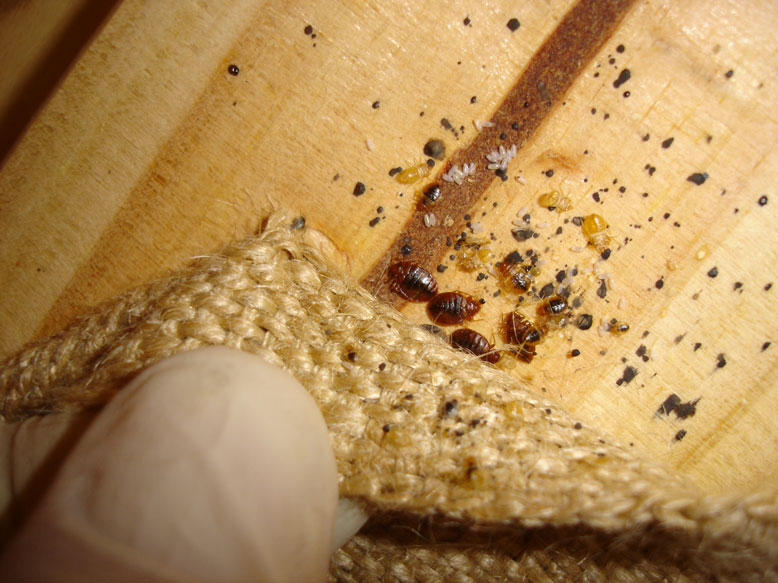
Photo from allbedbugs.com

The first thing you’ll want to do is to inspect your apartment for bed bugs before you move in.  You could either hire someone to do this or do it yourself.  In either case, you’ll want to do this before you move in because bed bugs can go undetected for months.  If you do choose to do this yourself, you’ll want to be sure to go through The Bed Bug Inspectors checklist.

  • Check for telltale signs.  You’ll want to check the floors and other surfaces for small black spots, shed bed bug skins, egg shells, live bed bugs (if you don’t know what they look like use the NYC Department of Health and Mental Hygiene checklist), and bloody or rusty stains.  Another sign is a sweet or offensive musty odor.
  • Uncover their potential hiding spots.  Take a flashlight and a magnifying glass and thoroughly inspect window and door frames, cracks and crevices, carpet tack strips, baseboards, behind outlet and switch plates, smoke detectors, thermostats, loose wall paper, molding, and wall junctions.

Once you made sure there are no signs of bed bugs, you’ll want to be sure to “bed bug proof” your home.  While you can’t prevent everything, there are some precautions you can take.  The first thing you’ll want to do is be sure to elevate your mattress off the ground.  You will also want to protect your mattress by using a protective mattress encasement, as well as protective pillow encasements.  You may consider using climb up interceptors on the feet of your bed frame.  These will help prevent and trap bugs from climbing onto your mattress.  You may want to monitor your home by conducting regular inspections and by placing bed bug traps around your home.  While this won’t solve the problem, it will certainly give you a definitive answer if your home is infested or not.

In order to prevent future infestations, you will want to be sure you are careful of where you stay and who is staying with you.  When you go on vacation, you can check the hotel you’ll be staying in by going to BedBugRegistry.com to see if there have been any bed bug reports.  You will also want to be sure to conduct an inspection of your room before you place your belongings down, and you will want to keep your belongings elevated off the floor at all times.

To ensure that your friends don’t bring bed bugs to your home, help them to inspect theirs.  Make sure they are as careful as you are about inspecting their home, and staying clear of places that could potentially have bed bugs.  With what you learn, you can help protect themselves too.
Standard
Ask the Expert, College Planning, Finances

ASK THE EXPERT: College Financial Planning, Part 2

For the second installment of “Ask the Expert:  College Financial Planning” series, we wanted to know what types of loans are available to students, and what are the distinctions between each of these types.  To find out more, we once again spoke with Mark Kantrowitz, an expert on paying for college, to give us the lowdown on loans.

Kantrowitz explains that there are two major types of student loans:  federal education loans and private student loans.  According to Kantrowitz, the federal loan has greater availability, better repayment plans, and is generally cheaper than a private loan.  He advises that the federal loan should be a student’s first choice when applying.  They will also be much easier to obtain in that they are offered through the Direct Loan program where students obtain federal loans through their college or university.

There are several different types of federal loans that are available to students.  The most common is the Stafford loan, in which there are two versions:  the subsidized and the unsubsidized.  According to Kantrowitz, there are a few main distinctions students should note when applying for subsidized and unsubsidized federal loans.  The first is that the subsidized version is based on financial need, while the unsubsidized version is not.  Even wealthy students can qualify for the unsubsidized Stafford loan.  Second, with the subsidized version, the government will pay the interest on the loan while the student is in school, and with the unsubsidized version, the government will not.  Thirdly, the interest rates for subsidized loans will be half of the rate (3.4%) as the rate for unsubsidized loans (6.8%) until tomorrow, in fact.  While there was a great deal of debate over how the government could afford to keep the rate the same, Senate majority and minority leaders  established an agreement that would enable the rate to remain at 3.4%.   According to Kantrowitz, this agreement will modify pension insurance premiums and drop eligibility for subsidized Stafford loans from students who are taking too long to graduate.

The other major distinction between subsidized Stafford loans and unsubsidized Stafford loans is the limit to which a student can borrow.  For the subsidized Stafford loan, a student may borrow up to $3,500 for their freshman year, $4,500 for their sophomore year, and $5,500 each for their junior and senior year.  Should the student require more aid, they may apply for unsubsidized loans.  However, there are limits as to how much one can borrow, either with a combination of subsidized and unsubsidized, or just from unsubsidized alone.  Overall, the limits are $5,500 for dependent freshmen students, $6,500 for dependent sophomore students, and $7,500 each for dependent junior and senior students.  If the student is filing as an independent, or their parents have been denied a loan, the borrowing rate is increased to $9,500 for their freshman year, $10,500 for their sophomore year, and $12,500 each for their junior and senior years.

The second type of federal loan available to students is the Perkins loan, which is given to students with exceptional financial need.  However, Kantrowitz explains that this is a very small loan program, and most students will not receive this type of loan.  Those students who do receive this type of loan will obtain between $1,000 and $2,000, on average.

The last type of federal loan Kantrowitz identifies is the PLUS loan, which is granted to the parents of undergraduates and to graduate students.  In either case, there is a 7.9% fixed interest rate, and eligibility is dependent on the borrower’s credit history. The PLUS loan also has a limit up to the full cost of education, minus any other aid received.  The Plus loan program is very popular, and only about one-fifth of those who apply will be denied due to bad credit.

While Kantrowitz explains that federal loans should be a student’s first choice, he also explains that a student may take out private loans should they require more funding.  However, Kantrowitz warns against some of the major pitfalls with private loans and denotes the differences between the federal and the private loans that should play into a student’s decision.    The first is that private loans are determined by individual lenders (not by the government), therefore these loans will vary significantly and will often have variable interest rates.  While some are introducing fixed interest rate options, this is something that students should consider when applying for private loans.

The second major consideration is that eligibility for these loans depends on one’s credit history and credit score.  In fact, Kantrowitz explains, more than 90% of these loans require a creditworthy cosigner as many students do not have any credit history or if they do, it is oftentimes very poor.  The higher of the two scores will then determine eligibility and the cost of the loan.  Kantrowitz gives us the example that if the loan has a variable rate, the interest on the loan would be a combination of a variable index plus a fixed margin, which depends on one’s credit score.  This means that the higher one’s credit score is, the less they will have to pay in interest on the loan.

Kantrowitz advises that “Your debt at graduation should be less than your expected annual starting salary.”  He explains that ideally, students should not be borrowing more than $10,000 each year for college.  If total student loan debt is less than annual income, the borrower will be able to repay their loan in 10 years or less.  Kantrowitz explains that “If your debt exceeds your annual income, you’ll struggle to repay the loan, and you’ll have to alter your repayment plan by income-based repayment or extended repayment in order to afford the monthly loan payments.”  This means that students will not only be stretching out their repayment, and therefore the amount of time they are in debt, but they will also be increasing the cost of the loan.  This means that they may still be repaying their own student loans when their children are looking to attend college.

For more information on financial aid and scholarships, visit www.finaid.org and www.fastweb.com.

Standard
Budget-Friendly Ideas

Afraid to cut the cord? Some not-so-scary alternatives to cable

When you’re thinking of cutting your expenses, you may want to consider cutting cable.  However, I’m sure as you read that some of you got the shudders, and some may have even passed out.  You may ask yourself (once you’ve picked yourself up off the floor), “How will I watch my favorite shows” or “How will I stay entertained?”  Well, we found a wide range of alternatives for you so that you can still watch your favorite shows but you don’t have to cringe every time you get your monthly bill.

You could opt for a subscription option.  These services offer you as much content as you can watch for a flat monthly rate.  Most of you have probably heard of Netflix, which offers you thousands of titles and only costs $7.99 for online streaming.  As not all of their titles are available to stream online, you may choose to increase your membership so that you can receive DVDs by mail.  This option, while it costs more, is only about $16 per month.  Similarly, Hulu Plus offers a service for $7.99 per month for unlimited online streaming.

Blockbuster offers a similar service, however, it does not allow you stream online.  This service costs about $9.99 if you want to get 1 DVD at a time, however, you can get up to 3 DVDs at a time for $19.99 per month.

If you can’t live without your baseball, you may want to get a subscription to MLB.tv.  This service also offers a flat rate for every out-of-market game, which you can watch as it’s happening or on demand.  This service ranges from about $84.99 per year (about $7 a month), to the most expensive plan at $298 per year (about $25 a month).

If you’re not looking to commit yourself to a monthly or yearly subscription, you may want to try a pay-per-view or per-episode service.  Apple iTunes offers TV shows from a wide array of networks like ABC, CBS, NBC, MTV, HBO, ESPN, Comedy Central, Disney Channel, and Showtime.  Episodes here range from about $1.99 to $2.99 per episode and can be streamed directly from your PC.  Amazon Instant Video also offers comparable prices for both TV shows and movies, and these too can be streamed directly from your computer.

Vudu allows viewers to rent movies and watch them from a variety of different devices, including the Xbox 360, a Playstation 3, a Blu-Ray player, an HDTV, an iPad, or a PC.  The price of this service is $2 per 2-day rental, and they offer new releases before other online streaming services like Netflix.

A slightly more “old-fashioned” way of renting a movie is through Redbox, which allows you to pick your movies up from any Redbox kiosk.  Standard DVDs cost $1.20 per day, Blu-ray discs cost $1.50 per day, and you can even rent video games for $2 a day.  Blockbuster also allows you to rent or purchase certain TV show and movie DVDs right from their website.  These prices for the newest releases are generally around $4 to $5 to rent (depending on quality), and about $13 to $18 to buy (also depending on quality).

If you’re looking to watch shows and movies on your TV, there is a wide range of devices that you can choose from.  Many gaming consoles today, in fact, have this capability, including the Xbox 360 and Playstation 3.  If you don’t own one of these consoles, you may want to consider devices like the Boxee Box ($149.99), the Sezmi (about $99), a Roku (from $49.99), or the Apple TV ($99).  Any of these devices will offer you a way to stream movies and TV shows from online to your TV.

Lastly, there are the free options (the best price EVER).  Hulu offers a large variety of TV shows and movies free to its users without any need for a subscription.  You can also find a lot of your favorite TV shows from those big broadcast networks like CBS, NBC, ABC, Comedy Central, and MTV right on their websites.  Other free services include Fancast, TV.com, Veoh, Joost, In2TV, and ESPN.go.com.

Whichever type of service or device you choose, you will certainly save when it comes to watching TV or movies.  In an article we read by Barbara Thau on DailyFinance, she explains that if you chose to pay for a $7.99 per month Netflix subscription, bought 3 seasons of your favorite TV show (say 13 episodes per season at 99¢) in iTunes from your Apple TV box ($99), watched TV shows for free on Hulu, and bought an MLB.tv subscription for the year for $84.99, you would spend $391.77 per year.  If you compare this to Verizon’s basic cable plan, which is $64.99 per month ($779.98 per year, not including the equipment), Cox’s basic bundle at $80.94 per month ($971.28 per year, without the equipment), or Comcast’s basic package, which costs on average about $59 per month ($708 per year), you would save, on average, about $400 per year.  So no matter what choice you make, you won’t have to feel so lost without cable because there are alternatives out there that will still help you to save and keep you entertained.

Some articles we referenced:

http://www.pcworld.com/article/187189-2/cable_cutters_cheap_alternatives_to_tv_dsl_and_cell_service.html

http://www.techflash.com/seattle/2010/03/best_alternatives_to_cable_tv.html

Standard
Ask the Expert, College Planning, Finances

ASK THE EXPERT: College Financial Planning, Part 1

For our newest blog series, we wanted to look at college planning and financial aid, as the student debt crisis has most certainly been a hot topic in the media recently.  For this series, we wanted to know exactly what students need to understand when it comes to financial aid, college financial planning, loan repayment, and student debt.  It just seems so complicated!

For the first installment in the “Ask the Expert:  College Financial Planning” series, we wanted to know what students should be concerned about when it comes to finances and applying for college.  To find out more, we spoke with Mark Kantrowitz, a noted financial aid and college planning author and publisher of FinAid and FastWeb, two resources for students looking to find out more about financial aid options available to them.

Kantrowitz tells us that students should ideally start looking at financial aid options as early as possible.  Often many students start looking their senior year, however, many of the deadlines have already passed.  Kantrowitz says that students looking to get scholarships should be planning for deadlines as early as junior year (if not earlier), so that they can get their applications in for those scholarships with deadlines in the fall of the their senior year.  He explains students should start considering financial aid as early as possible, as this increases the number of scholarships available to them, including those that they may earn in earlier grades.

According to Kantrowitz, when it comes to examining their options, they should weigh the cost of financial aid.  For students, he says, saving is always the better option.  “Every dollar you save is a dollar less that you’re going to have to borrow and every dollar you borrow, will cost you about $2 by the time you pay back the debt.”  It is simply the more affordable options, because when you save, you earn interest and when you borrow, you will pay interest. He gives us the example that, “If you were to save $200 per month for 10 years at 6.8% interest, you’d accumulate about $34,400.  If instead you were to borrow and pay back over 10 years at 6.8% interest, you’d pay $396/month.”  That would roughly double what one would pay if they were to save money instead.

Kantrowitz explains that students should also be aware of the actual cost of college.  He says that students should utilize a net price for college, which is the difference between the cost of attendance and just grants and scholarships.  “Think of it as a discounted sticker price.”  He explains that using this figure is a better basis for evaluating the cost of college rather than utilizing other cost evaluations.  Especially when it comes to the net price figures that schools will often provide on their websites.  Kantrowitz explains that these numbers will often include financial aid packages and loans, that do not actually lower the cost, but will rather increase the cost.

Kantrowitz also urges students to use caution with net price calculators that universities are now required to provide on their websites.  He explains that since October 2011 schools have mandated to host a calculator, however, he says that they really should only be used to determine a ballpark figure for net price.

According to Kantrowitz, there are a couple of major issues with these calculators.  The first major concern with these calculators is the number of questions the calculator has.  He says that much of the accuracy of these calculators is dependent upon the number of questions that they ask; while the standard calculator provided by the National Center for Education Statistics (NCES) contains approximately 10 questions, other calculators such as the one provided by the College Board, contain more questions.  The more questions a calculator has, the more accurate the calculator will be, he explains.  While these calculators are will mean more work for the user, they will produce much more accurate results.

The second concern Kantrowitz points out is that the age of data will play into the accuracy of the calculator.  He explains that calculators like those provided by NCES contain data that is approximately 2 years old, while those like the one provided by the College Board are current, and are more up-to-date.  In either case, Kantrowitz explains, one should use caution with these calculators and should not exclude any colleges on the sole basis of the figures provided by a net price calculator.

The last major concern Kantrowitz points to relates to the financial aid award letter.  He explains that students should be careful when they receive their financial award letter that they understand the characterization of the different awards and understand which award they were given.  “I’ve had families come to me thinking that they’re getting a free ride from a college, and when I look at the financial aid award letter I see $5,000 in student loans and $20,000 in parent loans.  That’s far from a free ride.”  Students should really do their homework when it comes to the different classifications of financial aid, so they know that when they receive a grant, they know which grant they have received and what this implies.

Overall, Kantrowitz urges students to start considering college financial aid early and often, and to do their homework when it comes to understanding the different options available to them.  He explains that students and their families should always exercise caution when it comes to financial aid and to make financial aid decisions that work best for them.

Standard
Housing Advice

Apartment Move In Checklist

Apartment-Move-In-Essentials-Checklist-Screengrab

Whether this is the first time you’re moving off campus, or you’ve been living off campus, it always seems like you’re forgetting something when it comes to packing everything you’ll need.  Trust us:  We’ve been there.  That’s why we’ve come up with a checklist of things you’ll need when you start packing up.  We know, it looks like one heck of a list, but you just never know what you’ll forget.

Click here to download a PDF copy.

BEDROOM

  • Bed
  • Night stand(s)
  • Bookcase/shelves
  • Lamps
  • Desk lamp
  • Trash can
  • Bureau
  • Desk chair
  • Rug(s)
  • Curtains
  • Curtain rod
  • Bed spread
  • Sheets
  • Plastic bins
  • Shoe rack
  • Full-length mirror
  • Alarm clock

KITCHEN

  • Silverware (at least 8 sets)
  • Plates (at least 4)
  • Bowls (at least 2)
  • Cups (at least 4)
  • Wine glasses (for those 21+)
  • Dish soap
  • Pots and pans (at least 1 skillet, 1 large pot, and 1 smaller pot)
  • Flat metal spatula
  • Large mixing spoon
  • Tupperware
  • Scissors
  • Paper towel holder
  • Microwave (if the apartment doesn’t come with one already)
  • Knife set
  • Dish rack (for next to the sink when you’ve finished washing them)
  • Table
  • Chairs (at least 2)
  • Sandwich bags (you may want gallon size and smaller sizes)
  • Aluminum foil
  • Plastic wrap
  • Pot holders
  • Oven mits
  • Strainer
  • Can opener
  • Cutting board
  • Large mixing bowl
  • Toaster or toaster oven

BATHROOM

  • Toilet brush
  • Toilet bowl cleaner
  • Plunger
  • Garbage can
  • Shower cleaner
  • Cleaning brush to clean shower
  • Shower shelves (optional)
  • Toilet paper
  • Shower curtain
  • Shower curtain rod

LIVING ROOM

  • Couch/chairs (depending on how much space you have)
  • TV (optional)
  • TV stand (also optional)
  • Lamps
  • Side tables/coffee table
  • Desk (you may want to include one in case you want to work in the living room)

MISCELLANEOUS

  • Hand soap (for both bathroom and kitchen)
  • Sponges
  • Paper towels
  • Tissues
  • Garbage bags
  • Broom and dust pan
  • Vacuum
  • Carpet cleaner (for those nasty spills)
  • Disinfectant wipes
  • Window cleaner
  • Light bulbs
  • Batteries
  • Extension cords
  • Flashlight
  • Fan(s)
  • Laundry detergent
  • Hamper/laundry basket
  • Clothes hangers
  • Basic hygiene products
  • First aid kit
  • Sewing kit
  • Basic tool kit
  • Fire extinguisher (if your apartment doesn’t already have one)
  • Smoke detector (your landlord should provide one, but you should make sure it works properly when you first move in)
  • Carbon monoxide detector (your landlord should also provide one of these, but you should make sure it works properly when you first move in)
  • Décor (i.e. picture frames, posters, decorative pillows, etc.)
Standard
College Planning

The “Going-Off-To-College” Essentials

Going off to college is, for many students, the first time you’ve lived away from home.  More often than not, you’ll probably be used to the comforts of home, where everything you could need is right at your fingertips.  That is why many are often confused as to what they actually have to bring when they start packing for college (so don’t worry, you’re not alone).

There’s a lot of considerations when it comes to what exactly you’ll be needing for the next nine months, so where do you start?  Well, while a lot universities will give you a basic checklist of what you’ll need, we put together a list of some of the things your school may include, and also some things they may not.

  • Microwave.  Most schools will allow you to have a microwave in your room.  You’ll definitely want to coordinate with your roommate beforehand to see who will bring what, but a microwave will be your best friend for those late night cram sessions.
  • Refrigerator.  Another dorm essential that you may want to coordinate on with your roommate.
  • Alarm clock.  In an article we read by Naomi Rockler-Gladen at Suite101.com, you will want to choose an alarm clock that is loud enough to wake you up.  You may also want to choose a battery-operated alarm clock, so if the power goes out in your building, you will still wake up in time for class.
  • Telephone.  Although a lot of students don’t go anywhere without their cell phone nowadays, you will still want to make sure that you have a cell phone with you when you move.  Rockler-Gladen says that you may also want to make sure that you have a plan that will fit your needs when it comes to making those daily phone calls to your friend in California.
  • Computer.  While a computer is not an absolute essential for college, it will make your life a lot simpler.  You’ll want to shop around for the computer that suits you best.  For example, if you’re trying to decide between a desktop and a laptop, you may want to consider where you want to do your studying.  Would you want to study in the library?  Would you want to bring your computer to class?  You’ll want to ask yourself questions like this to make the right decision for you.
  • Bathrobe.  If you’ll be living in a dorm with a bathroom at the end of the hallway, you will especially want to consider getting a bathrobe for those long walks back to your room.  Even if the bathroom is right next to your room, you’ll want to be sure that you won’t be giving your roommate a show.
  • Flip flops for the shower.  Trust us on this one:  you have no idea what is on that floor.
  • Shower caddy.  This makes those trips back and forth from the shower easier.  Pick a container that you can carry everything you’ll need in it, like shampoo, conditioner, soap, etc.  You may also want to choose one that is waterproof so that you can take it right in the shower with you.
  • Basic hygiene materials.  Although it seems obvious, you’d be surprised what you’ll forget.  You want to be sure to bring shampoo, conditioner, soap, toothpaste, mouthwash, etc.  Whatever you use on a regular to keep you clean you’ll want to bring with you.
  • Linens.  You may want to bring two sets of bed linens just in case one in is in the laundry.  You’ll also want to bring extra towels so that you don’t run into the same problem.
  • Cleaning materials.  Your best friend will be the disinfectant.
  • Medications and first aid.  You obviously will want to bring any medications you take on a daily basis.  But you also want to bring things like band aids, antibacterial ointment, antacids, cotton balls, etc.
  • Basic school supplies.  You’ll definitely need pens and pencils, but don’t forget things like printer paper, staplers, pencil sharpeners, and extra staples.  You may also want to get extra printer ink, in case you run out in the middle of printing out a paper the night before it’s due.
  • Good backpack.  Rockler-Gladen suggests that you get a backpack that you’ll be able to carry all your books and your essentials in.  If you’re bringing your computer to class, you may want to ensure that it will fit in your backpack.
  • Laundry materials.  You want to get laundry detergent, as well as a hamper and/or laundry basket to carry your clothes back and forth from the laundry room.
  • Rain jackets.  Trust us on this:  you’ll want a rain jacket with a hood.  You may also want to get a waterproof winter jacket if you’ll be somewhere where it snows.  We promise you when we say that you want to be prepared for all types of weather.  Remember that at most schools you’re classes will be in different buildings around campus.  That means that when it rains, you’ll have to walk through that.
  • Rain boots.  Again, you have to be prepared for everything.
  • Umbrella.  This is for the days where you could get away with just an umbrella, i.e. there isn’t wind accompanied with the rain.
  • Snow boots with treads.  Seems a little dorky, but trust us that you’ll need them.  If you’ll be in a place where it snows, you will want to make sure you don’t fall on your face walking to class.
  • Flashlight.  In case the lights go out or you lose something under your bed, you’ll want one of these handy.
  • Decor.  You’ll want to decorate your half of the room to remind you of home.  Don’t forget about those pictures that will get you through those long nights of studying.
Standard
College Planning

Tips for Preparing for College

If you’re heading off to college in the fall, you may have already realized that this summer is going to be intense.  While it’s probably the most exciting time in your life, it’s also the saddest, the scariest, and the most stressful.  It’s the time of graduation parties and group outings sending off everyone who’s going off to college.  However, it’s also that time you realize you won’t see those same people everyday anymore, the time you’ll have to meet a whole group of new friends, the time you realize you’ll most likely be living on your own in the fall, and the time you’ll have to prepare for all of this in 3 short months.  It’s nowhere close to being easy, however, there are some things that you can do to get everything in order and reduce some of your stress.

In an article we read by Lynn Jacobs and Jeremy Hyman in U.S. News and World Report, they suggest some tips to get you prepared.

  1. Go to orientation.  Although it seems pointless to you now, it’s something that will really help get your prepared for what is to come in the fall.  While those “ice breaker” activities may be killer, you’ll learn some important things about your school, including how to get around campus, what the dorms look like, and where to go if you need help.  This is also the time that you’ll set up your course schedule.  This way, you’ll know what to expect come September.
  2. Surf the school’s website.  Surfing the school’s website is a great way to see what majors they offer (if you haven’t decided yet or you’re considering double-majoring), you can see what on-campus activities there are, you can see what the requirements for your major will be, and you’ll get a taste for what other courses are offered.
  3. Friend your roommate.  When you find out who your roommate will be, you may want to initiate contact with them via Facebook or Twitter.  That way you can get a sense of who they are, what they’re like, and maybe you’ll get a chance to decide who’s bringing the fridge and who’s bringing the microwave.
  4. Get some furnishings.  When it comes to dorm room decorating, it isn’t a bad idea to start thinking of the things that you’ll need and the things that will make your half of the room seem a little like home.  You’ll want to make sure to bring desk lamps and bedding, but you may also want to consider some picture frames or posters to personalize your space.
  5. Improve your mind.  You’ll want to catch up on your reading, before your professors start packing on the required readings.  Believe us when we say that you won’t really get a chance to read for pleasure once the semester starts.
  6. Get wired.  If you don’t already have a computer, you’ll want to start shopping for one.  This doesn’t mean you have to buy one now, but you may want to start looking to see what’s out there, what you can afford, and what you couldn’t live without.  You may also want to wait until late July or August to purchase a computer.  A lot of stores willhave back to school deals on computers.  This will shave some of the cost for you, and you may get some an added bonuses like repair coverage or a rebate for an mp3 player. If you’re considering getting a desktop computer, you may want to consider the benefits having a more portable computer that you could bring with you to the library if you want to study there, or if you want to bring your laptop to class.
  7. Make a deal with your parents.  To avoid future conflicts with your parents, talk to them about how often you’ll be coming home, and how often they should expect to hear from you while you’re at school.  You may also want to talk about who will be covering what college costs, if you will be splitting some of the costs.  It’s worth the conversation now to save everyone the grief later.
  8. Service your car.  It’s the perfect time to make sure you get your oil changed and get an inspection before you head off to school.  If you’re leaving your hometown, this may be particularly helpful so that you won’t have to find a mechanic while you’re at school.
  9. Get yourself checked up.  You’ll have to make sure you’re up on all your vaccinations anyway before you head off to school, so you can also use this time to get a check up and fill any prescriptions you need.  While your school will most likely have a health service on campus, you may prefer to talk to your own physician beforehand.
  10. Organize your finances.  You’ll want to make sure that all your bank accounts and credit cards are set up and in order before you leave.  You’ll also want to make sure that you fill out all the necessary paperwork for any loans, scholarships, or financial aid you’ll need.
  11. Organize your life.  This is the perfect time to get a calendar or planner to start figuring out your schedule will look like.  When will you start classes?  When will you have finals?  When is your winter break?
  12. Start looking for part-time jobs.  To make a little extra cash, we suggest looking for a part-time job.  A lot of universities offer student positions, so you may want to check their employment websites.  You may also want to look around the campus to see if any businesses are hiring.
Standard
Roommates

7 Topics You Want to Discuss With Your Roommate(s)

Whether you’re subletting this summer or looking to move into a new place in the fall, you are bound to run into some issues with your roommate(s).  However, there are some things you can discuss with them beforehand that will help you nip some of these potential issues in the bud.

Music/TV

According to an article we read on ApartmentTherapy.com, if you’re sharing a room, you will want to discuss your tendencies when it comes to listening to music and watching TV.   Some people would prefer listening to music or watching TV with speakers, and other people would be fine with headphones.  You’ll want to see what each other’s preferences are and maybe come to a decision as to what times the speakers can be used.

Even if you aren’t sharing a room you want to be sure that you establish the use of the TV and/or stereo.  How will time be divided up amongst the roommates?  Will you have quiet hours?

Shared Items

In an article we read by Missy Slink in Yahoo! Voices, she explains that you will want to determine what items will be for community use and what items will not.  Will you share food?  If so, what foods will you be sharing?  Will you be sharing things like a vacuum?

You’ll also want to determine how and if you will be sharing things like toilet paper, paper towels, and cleaning products.  Will you each buy your own?  Will you be splitting this, and if you do decide to split this, how will you divide the cost amongst the roommates?

Sleeping Habits

If you’re sharing a room, this is especially important to discuss beforehand.  If you’re roommate goes to bed at 10 pm and you go to bed around 3 am, you’ll want to establish how you will manage this.  Does this mean you’ll switch to a desk lamp to study?  Can you watch television when they go to bed?

If you each have your own room, you will still want to discuss this so that you can properly set quiet hours.  This way you won’t be disturbing someone while they are trying to sleep.

Guest Habits

When you’re sharing a space, you’ll want to figure out what the guest policy will be for your room/apartment.  If you plan on having a lot of friends over, or you have a significant other, you will want to figure out when they can come over, when they can’t, and when guests should go home.  You may also want to determine what the ground rules will be for guests in terms of using shared items.

Security

As someone who has had roommates who leave all the doors unlocked, this is definitely something you want to discuss beforehand.  If you are someone who likes to make sure everything is locked up when you run to get coffee, or when you go to bed at night, you will want to talk about that beforehand with your roommate.

Decorating

If you’re sharing a room, you’ll want to determine if you want to share room decorations, or you want to set up your own spaces.  If each have your own separate bedrooms, you will still want to establish decorations for the common areas.

Concerns

You want to establish beforehand how and when you will raise concerns with one another should they arise.  It may be a little awkward to establish this beforehand, but you don’t want to be that roommate who leaves passive aggressive notes around when they get frustrated.  That won’t end well.

By establishing some ground rules beforehand and making sure you can live comfortably together, this will help you have a better roommate experience.  Just remember:  the space belongs to both of you.

For tips more tips on how to ensure fairness between you and your roommate(s), check out Splitwise and their blog at http://blog.splitwise.com/

Standard
Budget-Friendly Ideas, Finances

7 Easy Ways to Save a Little Cash This Summer

We know what it’s like being on a budget.  That’s why we decided to give you some easy options to save a little cash this summer and still have fun.

  • Circulating air more effectively rather than running the air conditioning.  According to an article we read at QuickandSimple.com, you can save more energy by opening windows and using portable fans or ceiling fans in every room.  This will both cut down on costs and is also more environmentally friendly.
  • Cancel cable for the summer.  By cancelling your cable subscription, you can save at least $20 a month (if you’re splitting the cost with a roommate).  This also gives you more incentive to go outside.
  • Make iced coffee at home.  In the article at QuickandSimple.com, they suggest making coffee slushes.  To make a coffee slush, take coffee and poor it into ice cube trays.  When the coffee has frozen, just pour the ice cubes with cream and sugar into a blender.  Hit “Blend,” and walah!  Iced coffee slush!
  • Carpool.  Either to work, to your summer class, or just going out with friends, you can save a ton when you carpool with friends. 
  • Shop at your local farmer’s market for produce rather than the grocery store.  According to QuickandSimple.com, spinach, cucumbers, tomatoes, string beans, and red bell peppers are in season right now.  You’ll save when you decide to buy local, as local farmers will often charge less than a store for produce that’s in season. 
  • Use your microwave.  In another article on QuickandSimple.com, using your microwave for four minutes will generate less energy than heating dinner in your oven for a half an hour.  This way you can save money and time.
  • Stay local.  You can have just as much fun in your area if you are “in the know” about what is going on.  In an article we read at MintLife, they make the point that by staying up-to-date with what is going on, you can often find free events in your area that might tickle your fancy.
Standard
Housing Advice, Renting

Subletting Your Apartment for the Summer

If you are going home for the summer or taking that internship in New York, you may want to consider subletting your apartment.  That way you won’t be paying for an empty apartment you’re not staying in.  However, there are some things you may want to consider before you do.

1.    Check with your landlord to see if you can sublet.  Not all landlords like people subletting their units, and if you sublet without their permission both you and your tenant could be evicted.  However, if they do allow subletting and/or you have a good relationship with them, they may let you.  In an article we read on eHow.com, they explain that you should only be subletting what you have the right to sublet.  This means that, for example, if you have a month-to-month agreement with your landlord, you want to make sure that your are subletting on a month-to-month basis.

2.    Talk to your friends to see if they would be interested.  It will be significantly easier for you to sublet for a few months to a friend rather than a stranger.  That way you can leave some of your personal belongings behind and you don’t have to worry about it.  It may also be easier for you to address your concerns with them, and for them to address their concerns with you.

3.    If you can’t find a friend, you may want to post up your sublet.  At JumpOffCampus we post sublets for anyone looking to sublet their apartment.  You can also post up your sublet around your campus to see if anyone at your school would be interested.  There may be someone taking summer classes that needs a place to stay for a few months.

4.    Set a reasonable rental price.  In a blog post we read by Kathleen Corlett on HerCampus.com, you want to set a price that won’t scare off any potential renters.  You have to be aware that you probably won’t get the full rent, so you want to take that into consideration.  You will most likely get about 75% of the actual rental cost.

5.    Whether your roommates are staying for the summer or they aren’t, you want to be sure in considering their opinions.  If they are staying for the summer, you want to be sure that they have a hand in deciding whom you will sublet to.  As they are the one(s) who will be staying with this person, you want them to be just as happy with your decision as you are.  If they aren’t staying for the summer, you want to be sure that you set ground rules togehter for the renter that both of you will be happy with.

6.     Meet the prospective tenants.  This way you can see who you will be renting to.  According to Corlett, there are a lot of rental scams out there.  You want to be sure that the person who you are renting to is legitimate and someone you feel comfortable with.  You can think of this process as kind of like a job interview.

7.    You want to be sure to draw up a written and binding agreement between the renter and yourself.  You want to be sure that the tenant agrees to pay the agreed amount each month and that they abide by the terms of your lease that you and your landlord had agreed upon.  In this agreement you may want to consider including any ground rules that you have established for the tenant.  Be sure to check with your landlord to see if they too have any additions to this agreement, or any additional paperwork they may need you or the tenant to fill out.

8.    Get a security deposit from the tenant.  This will ensure that you’ll be covered if there is any damage done to your apartment while your tenant is there.  you’re not left with a hefty bill or lose out on your own security deposit.

9.    Arrange for the tenant to send you money.  This way you will make sure the rent is paid directly to your landlord.

10. Make sure to clean up your place before you leave.  Cleaning before you leave is considerate, and is a great way to make sure none of your possessions get damaged or lost.

11.  Take photos before you leave.  That way you can verify what the apartment looked like when you left before the subtenant moved in.  You want to be sure to date this photo if it is not already time-stamped.  This is just in case any problems arise with damages or other incidents.

Standard