Ask the Expert

ASK THE EXPERT: Why Invest in Student Housing?

In an article we read by Amy Wolff Sorter at GlobeSt.com, the student housing sector has become a rather popular one in which to buy and sell due to rising enrollment rates and diminishing supply of on-campus options.  To get an insider look at some of the other draws (and disincentives) for landlords, property owners, and investors when it comes to student housing, we spoke with RI student property manager, Diane St. Laurent.

What do you believe sets student housing apart from other types of investment properties?
As an investor, student housing is desirable because rent payment is reliable especially when the landlord has the parents of the student secure the terms of the lease.  Another positive is that demand for student housing is always high.

Is there an advantage for investing in smaller scale properties for student housing versus larger scale properties?
When the landlord can establish a relationship with the students, so open communication can exist, then problems as they arise can be easily resolved.  Building communication is easier with smaller properties.  Large properties can impact the landlord-tenant relationship that is so important to build trust and mutual respect.

What amenities do you think are essential for student-leased properties to offer?
A fixed rent price that includes utilities is beneficial, if possible.  This helps students manage their finances and ensure the property is being maintained in terms of heat and electricity.
Students sometimes require furniture to be supplied, so if basic bedroom furniture, living room and dining room furniture are supplied, the number of prospective students may increase as a result.  This opens the door for exchange students from different countries and/or out-of-state, because these students may not be able to travel with this type of furniture.

What would you say is appealing about investing in student housing?
Steady increase in student demand.

What would you say is unappealing about investing in student housing?
Some undergraduate students (freshman, sophomore, junior) are not really ready for this type of responsibility.  Student choices usually reflect in them not taking care of the property; additionally, their social lifestyles sometimes lead to damage to the property and them being a nuisance to the neighbors.

What are some of the pitfalls associated with student housing?
When the landlord and student’s expectations, regarding respect of the property, are out of sync.

How do you believe the recession has impacted these kinds of investments?
My experience is that supply and demand has changed related to rent prices.  On one hand, there is an increase in student demand, but at the same time, students have fewer dollars to spend on rent.  There is a lot of competition for investors of student housing.  First, on-campus housing (dormitories and university apartments), private on-campus housing, off-campus housing, and finally student computers.
It comes down to what the student can afford and the individual student behavior.  Essentially, what are students looking for in housing?  This places added pressure on the investor to find ways to differentiate their property from all the rest.  Additionally, what student market the investor is looking at targeting has to be answered as well.

Do you believe that making an investment in student housing is worthwhile?
Yes I do.  It needs to be managed as a business, but at the same time, investors have to embrace the responsibility of helping students make good choices so they can assimilate to independence, maturity and advance their knowledge all at once.

What should property owners and investors know when it comes to owning and investing in student housing?
Students are young adults finding their way to independence, and sometimes their lifestyles are incompatible with the expectation of the landlord and the rules of the house.

What are some difficulties you often encounter when interacting with student tenants?
Sometimes the student is just not mature enough to be living in something other than a dormitory.

What are some important things to consider when interacting with student tenants?
Take on the mentor role by treating students as adults and hold them accountable for their decisions.
With that being said, I would emphasize student safety as the top priority.  This means landlords should have house rules documented, fire alarm inspections, routine heating and electrical system maintenance checks, and door locks changed between tenants.

Standard
Budget-Friendly Ideas, Housing Advice, Renting, Student Life

Finding Furniture For Cheap

If you’re renting for the first time and your apartment is unfurnished, you may be wondering how on earth you’re going to be able to furnish the entire place on your own.  As a student it’s especially difficult because you’re working with a smaller budget.  However, you do have options.  That’s why we’ve come up with some ideas to help you you aren’t breaking the bank when it comes to furniture shopping.

Ask the previous tenants.  If you get a chance, ask the previous tenants if they would be willing to leave some of their furniture for you.  It’s certainly worth a shot to ask them about specific pieces you would want and offer them an amount you would be willing to pay for each item.

Ask you friends and family.  It’s always worth it to ask your friends and family if they have extra furniture that they would be willing to sell to you.

Check online.  At JumpOffCampus, we offer a “Classifieds” section that will help you find furniture.  Just check your area and see what people have posted.  To check out this section of our site, go to http://www.jumpoffcampus.com/marketplace_listings .

You can also rent furniture online.  Currently we are now offering a deal on our resources page for our New York metro users to rent furniture from Cort Furniture for 10% off.  To check out this deal, just check out our website!

Check local yard sale listings and flea markets in your area.  You never know what you’ll find when you visit a yard sale or a flea market, but you may just find the piece of furniture you’re looking for at a significantly cheaper price.

THINGS TO CONSIDER:

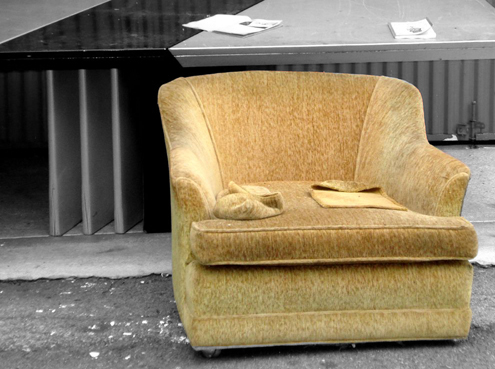
Don’t pick things up off the street.  Although it may seem like a great deal, you may end up with more than you bargain for.  Let’s just say that you get what you pay for, and at Free.99 you’re getting just that.  In most cases, it will probably be broken, damaged, or it will be carrying some unwanted guests (i.e. roaches, mice, bed bugs, etc.).

Any pest is a definite concern when you’re picking up used furniture, especially free furniture you find on the side of the road.  Our advice is to just leave that freebie alone.  In the end, it will potentially save you more money . . . and a huge headache.  Especially with bed bugs, they are extremely difficult to get rid of once you have them, and they can come from the cleanest of environments.  If you don’t believe it can happen, just check out this article from Suncoast News.

Inspect ALL used furniture for insects and pests BEFORE you bring it into your home.  As we’ve mentioned previously here and in our post about bed bugs, you need to be especially careful that you aren’t bringing any unwanted guests into your home.  Be sure to use proper inspection procedures to make sure you’re safe.

Inspect ALL furniture for broken or damaged parts BEFORE you pay for it.  This one is pretty self-explanatory, but you don’t want to pay for something you can’t use.  You want to inspect anything before you purchase it to make sure that nothing is broken or appears poorly constructed.  In an article we read by Laura Coffey at Today.com, she explains that you should be sure to inspect all the furniture IN PERSON before you purchase it.  That way you can be sure you are getting what you are paying for.

Plan ahead for transportation.  According to Coffey, you want to be sure to prepare to transport the piece before you purchase something.  This includes moving it from where you bought it and moving it into your place.  You may also want to consider how you’ll move it out when you leave.  Measuring is a great way to do this and to ensure that you aren’t buying furniture you can’t even get into your apartment.

Standard
Dear JumpOffCampus..., Housing Advice, Student Life

READER QUESTION: How much money can you expect to spend on groceries per month in Boston?

It’s slightly difficult to answer this question with one number because what people buy, where they buy it, and when they buy it all plays into the equation. While our co-founders Mark and Kyle (who have lived in Boston) explained that you could get away with spending $100 per month, it may be a little difficult. Instead, we’ve put together some tips for you on how to find the cheapest alternatives and how you can limit your costs.

From our experience, if you’re trying to limit your costs, you may want to choose grocery stores that don’t sell only organic products. While we aren’t hating on organic eating, if you’re a college student trying to live on a very strict budget, it may not be the most price-friendly option.

We also suggest choosing stores that offer the best deals in their weekly circulars and coupons. While coupon clipping may not be something you considered before, it will save you a significant amount of money in the long-run. Some stores that offer some great deals include places like Stop and Shop, Shaw’s, and Market Basket (a chain of stories specific to Massachusetts and New Hampshire). Memberships to stores like Sam’s Club and BJ’s will also help you to save money. You can split the membership fee (only about $50 a year) with your roommates, and you can buy items like toilet paper, paper towels, and bottled water in bulk, which will help limit your costs when you go to the grocery store.

Another way to limit your spending is by sharing the cost with a roommate. If each of you has your own carton of milk, it will end up taking up a lot of space in your fridge. Save space and money by splitting the cost of items like milk, eggs, and condiments that you can all share.

You can save a lot of money by putting together a budget of what you want to spend each week. You will probably have to do shopping about once a week, especially if your buying items like fruit and vegetables, but you can break down those trips into 2 larger and 2 smaller trips each month. Every other week you can make a larger shopping trip where you stock up on nonperishable items (canned soups, canned vegetables) and other items that won’t spoil in 2 weeks. In between those trips, you can make a smaller weekly shopping trip and buy just perishables and other items you’ve run out of. You could easily set yourself a budget of about $25-30 during those smaller trips and $100 during those larger trips. This way your total for the month is about $250. You could even limit that further by buying store brand foods, and buying only the essentials.

We hope this helped to answer your question. If you have any other questions or suggestions for any topics you would like us to cover on our blog, feel free to drop us a line at advice@jumpoffcampus.com!

Standard
Meet Our University Partners

MEET OUR UNIVERSITY PARTNERS!

Meet Greg Jones, Assistant Director for Operations and Off-Campus Housing at Brandeis University!

What are the benefits you see of using JumpOffCampus?  How do you believe JumpOffCampus has helped Brandeis?

I think it’s been really helpful because the interactive map feature makes it easy to use for students and it’s easy to use for landlords.  It’s really changed the ways that students are looking for housing in terms of the information that landlords are able to provide, the information that students are able to see and use, and the ease of searching for housing.

Where did you attend college?  What was your major?

I went to Haverford College in Pennsylvania. My major was history.

What does your job entail?

My title here at Brandeis is Assistant Director for Operations and Off-Campus Housing.  I run everything with housing assignments here, from running room selection, first-year assignments, new student assignments, and the opening and closing of buildings.  With off-campus housing, I advise and support students who live off-campus.  A lot of the time it’s about providing them with resources, sending them to the right places to find housing, and helping them out with issues and problems.

How long have you been working in community living?

I’ve been in this department for 5 years.  I’ve been the assistant director here for the last 2 years.

How did you get into the field of university community living?

After I finished my undergrad, I got a Master’s in Higher Education Administration and Policy from Northwestern University.  I really wanted to work in student affairs due to a lot of my undergraduate experiences at Haverford, including working with housing orientation and the first-year program.  I went to work at Brandeis for many reasons; it’s location, student body, and the university’s mission of social justice.  It’s been a great home for me these last few years.

What do you feel is the most important or difficult part of your job?

I think that the most important part is to make sure that everyone is getting what they need from housing and getting what they need from off-campus housing.  Needs are really about safety, [meaning] that they have a safe place to live, that they feel comfortable where they’re living, [that] they feel like they have access to the resources they need to be successful at college, and that they are taken care of the way that they need to be.

What is your favorite part of your job?

My favorite part is working with students: having interactions with them, helping them out when they encounter difficulties, and helping them to find a solution for themselves.  It’s a lot of fun interactions that you get to have with college students.  It’s a really fun and interesting population.  Everyday is always a little different and there’s never a dull moment.

What is your favorite college memory?

I don’t think I have a single day or instance.  The connections I made at college, the people, the place, and the community, those were the things that were important to me then and that’s why I love my undergraduate experience.  It has to do with the people that I was with and just being a part of that campus and that campus’s community.

What kind of music do you listen to?

Recently I’ve been mourning for Whitney, so I’ve been listening to her a lot.  Some Adele, Aimee Mann is always on my playlist.  I would say standard pop rock, little folk here and there.

What are your hobbies?

Love to cook:  always in the kitchen, always cooking something new.  Trying new recipes, things like that.  I don’t know it’s a hobby, but just going to the beach; going out to the shore is always really nice.  Trying out new restaurants: it’s a very expensive hobby but it’s one I enjoy very much.

Standard
Housing Advice

Reducing Home Allergens

While allergies symptoms can range from mild to severe, according to the Asthma and Allergy Foundation of America, approximately 60 million Americans suffer from asthma and allergies.  Approximately 40 million suffer from indoor/outdoor allergies as their primary allergy.  The most common triggers being trees, grass and weed pollen, mold, dust mites, cockroaches, and cat, dog, and rodent dander.   Food allergies account for approximately 6% of allergy suffers, and the most common triggers are milk, soy, eggs, wheat, peanuts, tree nuts, fish, and shellfish.

If you have allergies, you may have experienced sniffling, sneezing, watery eyes, headaches, or worse.  It can be a very unpleasant experience when you your allergies flare up.  While there isn’t much you can do to rid yourself completely of your allergies, there are certainly some simple things you can do around your home that will help to reduce allergens.

Use an allergen impermeable cover to enclose your mattress, box spring, and pillows.  In an article we read by Mikki Hogan at The Allergy Spot, the first area you want to consider is your bed and your bedroom.  Dust and dust mites found on your bed can be a major trigger for your allergy symptoms.  These covers will help trap any allergens that may be on your mattress, and will prevent them from being inhaled.

Wash sheets, pillowcases and blankets in hot water at least once per week.  Hogan explains that hot water will kill all dust mites and removes allergens from the fabrics.  By accompanying this with hypoallergenic fabrics, you can greatly reduce the potential for your symptoms to flare up.

Vacuum floors regularly.  By vacuuming carpeting and other flooring, you can greatly reduce dust and other allergens that can accumulate.  You can use dry carpet cleaners to further remove allergens.  According to Hogan, shampooing carpets can leave residual moisture than can increase dust mite growth.  You may also want to consider using a vacuum with a HEPA filter.

Dust regularly.  Be sure to dust every area that could potentially collect dust.  You may also want to consider clearing any clutter or messes regularly to prevent the collection of dust.

Wash curtains and blinds monthly.  In another article we read by Clean Air Plus, when purchasing curtains, you will want to consider washable fabrics so that you can wash them safely without damaging them.  You will also want to take a clean washcloth and wipe down window blinds.  Both curtains and blinds are primary locations for dust collection.

Regularly vacuum and clean furniture.  Ensuring that couches, tables, shelves, etc. are regularly cleaned will also help to greatly reduce dust and other allergens.  Be sure to remove the appropriate cleaners for woods and fabrics.  Vacuuming can be especially helpful on cloth-based furniture.

Regularly clean shower and tub areas.  Because these areas are generally damp, they can become breading grounds for mold and mildew.  To ensure that mold and mildew do not build up, regularly clean these areas with the appropriate cleaners.

Avoid opening windows when pollen is active.  This is pretty self-explanatory, but this will help ensure that no pollen gets in and it will decrease the number of allergens inside your home.

Standard
Housing Advice

Apartment Security

In our experience, locking the door for college students seems to be a problem sometimes.  We’ve heard many stories when we were in college of students getting their possessions stolen simply because they or their roommates had left the door open or unlocked.  This is why we decided to give you some tips to make sure that it doesn’t happen to you.

Gauge the safety of the area you live in.  You can check local police logs to see where crime is occurring in your area.  If you notice someone has been robbed only one block over from your apartment, you will want to be especially careful.  In an article we read at My First Apartment, they suggest using websites like Everyblock which will also help you to gauge the relative safety of your neighborhood.   They also advise you to be aware of suspicious people who may be casing your apartment, and to consider your risk tolerance.  This means that if you know you live in an area that is a little sketchy, you understand that there will be risks.

Make sure your apartment and your building has working locks.  You want to make sure that the locks to your apartment and to the building work before you start moving in your things.  Be sure to examine the locks to ensure that nothing seems to be broken.  Then you’ll want to lock yourself out (with someone still inside who can let you in), and try to break in (without damaging anything).  You want to make sure that you can’t break into your apartment.  If you notice anything, or you find it to be really easy to get in, you’ll want to let your landlord know immediately.

If you don’t have a deadbolt, ask your landlord to install one.  In another article we read at My First Apartment advises that this is the most important piece of security for an apartment.  Deadbolts are much more difficult to pass, as they require a significant amount of force to be opened.

Don’t let people into your apartment or your building who you don’t know.  You should not open the door for anyone you don’t know.  Before you open the door, it is important to ask who it is.  You should also beware not to let anyone into your building who you don’t know.  If someone approaches you looking to get into your apartment building because they “locked themselves out” and you don’t know them, you shouldn’t let them in.

Be sure to store important and expensive valuables out of sight and in not-so-obvious places.  In one of the articles we read, they suggest that you make sure that you store things out of sight so that if someone were to break into your home, that they may not be able to find all of your jewelry in one obvious spot.  You may also want to be sure that no one can see the giant flat screen sitting in your living room.  Especially if you have a first floor apartment, you’ll want to make sure that you draw the blinds so that no one can see in and that you may have added security on your windows and doors (i.e. bars or extra security locks).

Talk with your roommate(s) beforehand about security.  Although it sounds a little strange, you want to know beforehand if your roommate never locks the door.  Sit down together and discuss how the security for your place should be handled.  Can you leave the door unlocked if you just ran outside for 5 minutes?  Can you leave the door unlocked when you’re home?  Whose responsibility is it to make sure the door is locked at night?  You’ll also want to talk about the aforementioned items we’ve listed here and develop a strategy as to how you and your roommate(s) can prevent your pad from becoming an easy and obvious target.

Standard
Ask the Expert, College Planning, Finances

ASK THE EXPERT: College Financial Planning, Part 4

For the fourth installment of “Ask the Expert: College Financial Planning” series, we wanted to know how college housing choices effect financial aid decisions. To find out more, we spoke again with Mark Kantrowitz, college financial planning expert and publisher of FinAid.org and FastWeb.com.

According to Kantrowitz, room and board are factored into the cost of college attendance, making it an expense covered by a student’s financial aid package. If a student chooses to live on-campus, their room and board would be based on the dormitory fees and the standard meal plan fee. If the student chooses to live at home with their parent(s) or guardian(s), rarely will they receive any financial aid for their housing accommodations.

If the student lives in an off-campus property (other than at home), the student will be afforded an allowance within their financial aid package to cover the cost of their housing. However, this price will be an arbitrary average rent price that is based on occasional rent surveys, and as Kantrowitz explains, universities are very reluctant to change these figures once they have been set. This means that if a student chooses to live in a property that is more expensive than the housing allowance, the university will not alter their allowance to accommodate the greater price. The only circumstances in which Kantrowitz sees this change being made is when the student has extenuating circumstances, such as a disability or having a dependent, which would require them to choose a more expensive residence.

For this reason, Kantrowitz advises students to try to stay within their budgets when it comes to off-campus housing. He explains “Just because you have an allowance that says you can pay up to this amount per month for rent, doesn’t mean that you should spend that amount. This is because in most cases the money that you’re spending on your living expenses is going to come in the form of loans, not grants.” By spending up to the allotted amount or above that amount, this will not only increase the student’s expenses per month, but it will also increase the amount of debt the student will have to pay off when they graduate.

Standard
Cooking, Housing Advice

Starter Pantry Essentials Checklist

When you’re moving off-campus for the school year, there are a lot of things to consider.  If your living in an unfurnished pad, in particular, there are a lot of things you have to remember to pack.  While it’s important, I’m sure many of you may forget the important essentials you’ll need to stock your pantry with when you move in.  It’s not like at home where your mom always had some chicken noodle soup in stock.  You’re on your own!

Knowing from our experience, we wanted to make sure you weren’t left out in the cold if you didn’t get to go grocery shopping one week.  Thanks to a couple articles we read at MyFirstApartment.com, we’ve come up with a list of things that every college student living off-campus needs to keep themselves fed.

  • Canned beans
  • Canned soups
  • Canned tomatoes
  • Pasta sauce
  • Spices (you at least want garlic powder, onion powder, salt, and pepper)
  • All-purpose flour
  • Sugar
  • Vanilla extract
  • Baking powder
  • Baking soda
  • Vegetable oil (optional)
  • Olive oil
  • Vinegar
  • Dried pasta
  • Instant oatmeal
  • Mustard
  • Ketchup
  • Coffee/Tea
  • Cereal
  • Honey
  • Hot cocoa
  • Rice

The articles we referenced:

http://www.myfirstapartment.com/2011/10/first-apartment-pantry-essentials/2/

http://www.myfirstapartment.com/2005/11/starter-pantry-and-staples-checklist/

Standard
Housing Advice, Roommates, Student Life

How to Deal with Roommate Issues

Let’s be honest here:  You and your roommate(s) are never going to see eye to eye on everything.  Whether it is about doing dishes, who’s buying the paper towels, or whether they can have friends over at 12 am on a Tuesday night, things are going to come up that you just won’t agree on.  However, you certainly don’t want to end up in a bickering match or giving each other the silent treatment for the rest of the year.  This is why you need to be prepared before it comes time for you to have a talk.  In an article we read at MSN.com, they gave some tips on how to talk with your roommate when problems arise:

  • Avoid passive aggression.  The sticky note you leave your roommate detailing their wrong doings never goes over well (beware not get yourself on this site!).
  • Emphasize the positive.  Before you talk with your roommate, be sure to make a list of their positive qualities.   This will help to remind you what you like about them, and it will help keep you positive when you talk with them.
  • Consider how you could be contributing to the situation.  Usually issues in a relationship are never black and white.  Maybe your roommate never does the dishes because you never do.  You will want to consider how you could make changes too.
  • Be prepared.  NEVER GO INTO A SITUATION LIKE THIS UNPREPARED.  I repeat:  NEVER GO INTO A SITUATION LIKE THIS UNPREPARED.  This is perhaps the most important item on this list.  If you go into a situation like this with your roommate and you have not thought about what you are going to say beforehand, a myriad of (not-so-good) things can happen.  However, what will most likely happen is one of two things:  1) you won’t actually say what you meant to say, or 2) you won’t say it right and it will cause more friction between you and your roommate.  Be prepared!  Think about what you want to say and how you want to approach the situation.  You’ll also want to consider their possible reactions and how you will approach their responses.  You may even want to write down some notes and practice what you’ll say beforehand.  You don’t have to be afraid to talk with your roommate; you just have to be prepared.
  • Pick a comfortable location and time to talk.  You want to pick a time and place where both you and your roommate will be relaxed.  You may even want to set up a time with your roommate to talk with them.  This will help to prevent any outside influences (work, school, etc.) from affecting the outcome of your talk.
  • Be tactful, even-tempered, and clear.  Be clear about what you want to change, and make sure there are no “grey” areas.  You want to keep a cool head and be strategic about how you say what you need to say.  At least then one of you will be levelheaded.
  • Use “I” statements versus “you” statements.  Be sure to avoid focusing the discussion on what your roommate is doing wrong.  Instead focus on how the situation and their behavior makes you feel.  This way you’ll prevent them from shutting out what you are saying.
  • Don’t wait too long to talk to them.  Talk to them within a reasonable amount of time.  If your roommate had a party while you were away, you don’t want to wait 3 months after the fact.  Talk to them within a couple days of when you return.  This way it will be fresh in both of your minds, and it will prevent any future incidents.
Standard
Apartment Hunting, JumpOffCampus

Apartment Hunting Checklist

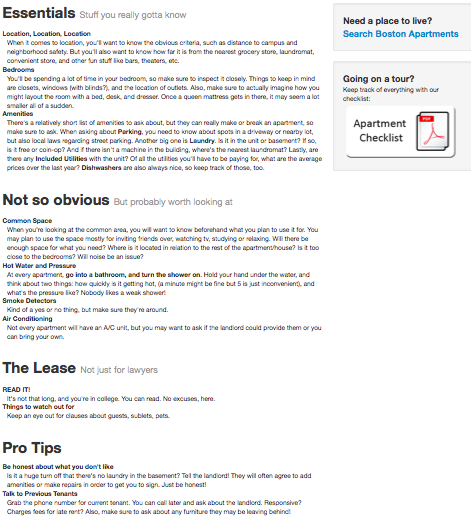
Whether it is your first time renting or not, it can be difficult to determine what you should be looking for when it comes to your apartment search.  There are a lot of factors to consider, and this is why we’ve put together a checklist for you to bring with you when you start your search.

The checklist we’ve designed helps you to keep track of what the apartment includes, and provides you with a way to compare different properties all at once.    We have also included insider tips on the obvious and the not-so obvious things you should be looking for when you visit a property.

A checklist like this is a useful tool when you start your apartment search.  You should never rent an apartment based on appearance only, and you should never rent an apartment just based on photographs.  We always suggest that you actually visit the listing before you sign on the dotted line.  It is important that you make sure that the property is exactly as it was listed and that it fits your needs.

To download a copy of our checklist and to view other tips on apartment hunting, go to http://jumpoffcampus.com/resources/checklist.

Standard