Housing Advice

Apartment Security

In our experience, locking the door for college students seems to be a problem sometimes.  We’ve heard many stories when we were in college of students getting their possessions stolen simply because they or their roommates had left the door open or unlocked.  This is why we decided to give you some tips to make sure that it doesn’t happen to you.

Gauge the safety of the area you live in.  You can check local police logs to see where crime is occurring in your area.  If you notice someone has been robbed only one block over from your apartment, you will want to be especially careful.  In an article we read at My First Apartment, they suggest using websites like Everyblock which will also help you to gauge the relative safety of your neighborhood.   They also advise you to be aware of suspicious people who may be casing your apartment, and to consider your risk tolerance.  This means that if you know you live in an area that is a little sketchy, you understand that there will be risks.

Make sure your apartment and your building has working locks.  You want to make sure that the locks to your apartment and to the building work before you start moving in your things.  Be sure to examine the locks to ensure that nothing seems to be broken.  Then you’ll want to lock yourself out (with someone still inside who can let you in), and try to break in (without damaging anything).  You want to make sure that you can’t break into your apartment.  If you notice anything, or you find it to be really easy to get in, you’ll want to let your landlord know immediately.

If you don’t have a deadbolt, ask your landlord to install one.  In another article we read at My First Apartment advises that this is the most important piece of security for an apartment.  Deadbolts are much more difficult to pass, as they require a significant amount of force to be opened.

Don’t let people into your apartment or your building who you don’t know.  You should not open the door for anyone you don’t know.  Before you open the door, it is important to ask who it is.  You should also beware not to let anyone into your building who you don’t know.  If someone approaches you looking to get into your apartment building because they “locked themselves out” and you don’t know them, you shouldn’t let them in.

Be sure to store important and expensive valuables out of sight and in not-so-obvious places.  In one of the articles we read, they suggest that you make sure that you store things out of sight so that if someone were to break into your home, that they may not be able to find all of your jewelry in one obvious spot.  You may also want to be sure that no one can see the giant flat screen sitting in your living room.  Especially if you have a first floor apartment, you’ll want to make sure that you draw the blinds so that no one can see in and that you may have added security on your windows and doors (i.e. bars or extra security locks).

Talk with your roommate(s) beforehand about security.  Although it sounds a little strange, you want to know beforehand if your roommate never locks the door.  Sit down together and discuss how the security for your place should be handled.  Can you leave the door unlocked if you just ran outside for 5 minutes?  Can you leave the door unlocked when you’re home?  Whose responsibility is it to make sure the door is locked at night?  You’ll also want to talk about the aforementioned items we’ve listed here and develop a strategy as to how you and your roommate(s) can prevent your pad from becoming an easy and obvious target.

Standard
Apartment Hunting, JumpOffCampus

Apartment Hunting Checklist

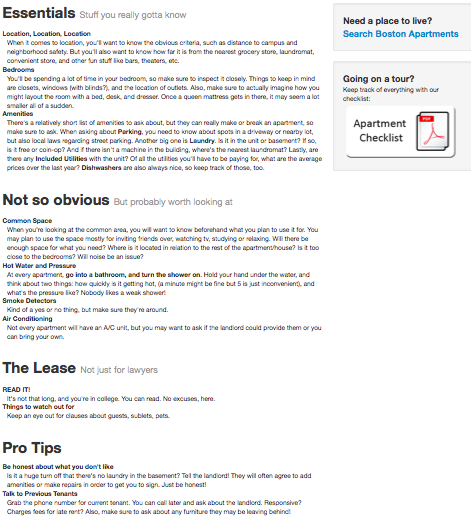
Whether it is your first time renting or not, it can be difficult to determine what you should be looking for when it comes to your apartment search.  There are a lot of factors to consider, and this is why we’ve put together a checklist for you to bring with you when you start your search.

The checklist we’ve designed helps you to keep track of what the apartment includes, and provides you with a way to compare different properties all at once.    We have also included insider tips on the obvious and the not-so obvious things you should be looking for when you visit a property.

A checklist like this is a useful tool when you start your apartment search.  You should never rent an apartment based on appearance only, and you should never rent an apartment just based on photographs.  We always suggest that you actually visit the listing before you sign on the dotted line.  It is important that you make sure that the property is exactly as it was listed and that it fits your needs.

To download a copy of our checklist and to view other tips on apartment hunting, go to http://jumpoffcampus.com/resources/checklist.

Standard
Budget-Friendly Ideas

Afraid to cut the cord? Some not-so-scary alternatives to cable

When you’re thinking of cutting your expenses, you may want to consider cutting cable.  However, I’m sure as you read that some of you got the shudders, and some may have even passed out.  You may ask yourself (once you’ve picked yourself up off the floor), “How will I watch my favorite shows” or “How will I stay entertained?”  Well, we found a wide range of alternatives for you so that you can still watch your favorite shows but you don’t have to cringe every time you get your monthly bill.

You could opt for a subscription option.  These services offer you as much content as you can watch for a flat monthly rate.  Most of you have probably heard of Netflix, which offers you thousands of titles and only costs $7.99 for online streaming.  As not all of their titles are available to stream online, you may choose to increase your membership so that you can receive DVDs by mail.  This option, while it costs more, is only about $16 per month.  Similarly, Hulu Plus offers a service for $7.99 per month for unlimited online streaming.

Blockbuster offers a similar service, however, it does not allow you stream online.  This service costs about $9.99 if you want to get 1 DVD at a time, however, you can get up to 3 DVDs at a time for $19.99 per month.

If you can’t live without your baseball, you may want to get a subscription to MLB.tv.  This service also offers a flat rate for every out-of-market game, which you can watch as it’s happening or on demand.  This service ranges from about $84.99 per year (about $7 a month), to the most expensive plan at $298 per year (about $25 a month).

If you’re not looking to commit yourself to a monthly or yearly subscription, you may want to try a pay-per-view or per-episode service.  Apple iTunes offers TV shows from a wide array of networks like ABC, CBS, NBC, MTV, HBO, ESPN, Comedy Central, Disney Channel, and Showtime.  Episodes here range from about $1.99 to $2.99 per episode and can be streamed directly from your PC.  Amazon Instant Video also offers comparable prices for both TV shows and movies, and these too can be streamed directly from your computer.

Vudu allows viewers to rent movies and watch them from a variety of different devices, including the Xbox 360, a Playstation 3, a Blu-Ray player, an HDTV, an iPad, or a PC.  The price of this service is $2 per 2-day rental, and they offer new releases before other online streaming services like Netflix.

A slightly more “old-fashioned” way of renting a movie is through Redbox, which allows you to pick your movies up from any Redbox kiosk.  Standard DVDs cost $1.20 per day, Blu-ray discs cost $1.50 per day, and you can even rent video games for $2 a day.  Blockbuster also allows you to rent or purchase certain TV show and movie DVDs right from their website.  These prices for the newest releases are generally around $4 to $5 to rent (depending on quality), and about $13 to $18 to buy (also depending on quality).

If you’re looking to watch shows and movies on your TV, there is a wide range of devices that you can choose from.  Many gaming consoles today, in fact, have this capability, including the Xbox 360 and Playstation 3.  If you don’t own one of these consoles, you may want to consider devices like the Boxee Box ($149.99), the Sezmi (about $99), a Roku (from $49.99), or the Apple TV ($99).  Any of these devices will offer you a way to stream movies and TV shows from online to your TV.

Lastly, there are the free options (the best price EVER).  Hulu offers a large variety of TV shows and movies free to its users without any need for a subscription.  You can also find a lot of your favorite TV shows from those big broadcast networks like CBS, NBC, ABC, Comedy Central, and MTV right on their websites.  Other free services include Fancast, TV.com, Veoh, Joost, In2TV, and ESPN.go.com.

Whichever type of service or device you choose, you will certainly save when it comes to watching TV or movies.  In an article we read by Barbara Thau on DailyFinance, she explains that if you chose to pay for a $7.99 per month Netflix subscription, bought 3 seasons of your favorite TV show (say 13 episodes per season at 99¢) in iTunes from your Apple TV box ($99), watched TV shows for free on Hulu, and bought an MLB.tv subscription for the year for $84.99, you would spend $391.77 per year.  If you compare this to Verizon’s basic cable plan, which is $64.99 per month ($779.98 per year, not including the equipment), Cox’s basic bundle at $80.94 per month ($971.28 per year, without the equipment), or Comcast’s basic package, which costs on average about $59 per month ($708 per year), you would save, on average, about $400 per year.  So no matter what choice you make, you won’t have to feel so lost without cable because there are alternatives out there that will still help you to save and keep you entertained.

Some articles we referenced:

http://www.pcworld.com/article/187189-2/cable_cutters_cheap_alternatives_to_tv_dsl_and_cell_service.html

http://www.techflash.com/seattle/2010/03/best_alternatives_to_cable_tv.html

Standard
Finances, Roommates

Splitwise

If you don’t watch TV that often, but your roommate does, is it fair for you to pay half of the cable bill?  If you have the bigger room in the apartment, is it fair for your roommate to pay half of the rent?  Well, with Splitwise, you can make sharing expenses a more fair, and less awkward process.  Recently we sat down with Splitwise CEO, Jon Bittner, about what his company does and what Splitwise can do to make splitting the bill fun and easy.

What is Splitwise?

Spitwise is a great way for roommates to keep track of their shared expenses, make sure everyone pays their bills, know who owes who, and make living with room­­mates a harmonious and fun experience.

What is the philosophy behind Splitwise?

At Splitwise, we want to make it stress-free to split expenses with your friends.  One part of that is that it’s really fun and easy if people don’t have to be constantly paying each other.  It’s annoying to collect money from your friends because no one ever has the right amount of cash on hand and sending checks or e-payments around is all very annoying.  What we have created is a virtual account or tab for your group that makes it really simple to keep track of who’s paid for which bills, make sure everyone has paid their fair share every month, and then they can settle it up.

Another thing that we do, that might be helpful to students who are looking for apartments on JumpOffCampus, is to help you to figure out how you should split the rent with your roommate.  Our philosophy about rent splitting is that it is really awkward to haggle about how much each person should be contributing to rent.  As soon as you decide to share a new apartment, you can just put in the variables and our rent calculator will give a neutral recommendation for how much each bedroom should cost. It takes into account bedroom size, windows, whose sharing a room, and some other stuff like that. At Splitwise, we want to make it really fun and enjoyable to live with roommate.  Splitting up the rent for roommates is just one way to avoid a fight. We’re very excited to have JumpOffCampus feature it on their site.

How did Splitwise get started?

A few years ago I was living with my then-girlfriend, now fiancé, and we had a roommate named Tory who was wonderful.  We had agreed to split the rent equally (each person).  It was an expensive place in Boston; we each had to pay, I think, $800 a month for this really nice place. It seemed fair because we had a huge bedroom and Tory had a normal-sized bedroom.  It seemed fair to do it this way – we had a lot of space, maybe twice as much space as her.  But I started to think, was that fair?  Was I being unfair to my friend?  I thought about it, and so I created a survey and sent it to my friends asking a bunch of hypothetical questions about what would be fair for all these different variables.  Some of them were about the situation that I was in, and some were just in the abstract.  When I put it all together I decided to create a little rent calculator that would incorporate all of that data I had just taken.  I put that on the Internet and people have just loved it.  We’ve had over 100,000 people use it, even just in the first month, and hundreds of thousands more since.  It’s a great tool and I know that people get a lot of value from having some suggestions, some sort of neutral arbitrator or neutral third party, that can recommend something when you’ve never done this before, or even if you’ve done it before but you haven’t been in this exact situation.

What do you believe is the hardest part of splitting the bill?

There’s doing the math, having the cash on hand (the exact change which no one ever has), and the awkwardness of “Did you put in enough?”  “Why are we short? Did you have an appetizer?”  “Oh, there’s too much money.  Who does it go back to?”  That could be for a restaurant bill, of course (a common one), or even for like a utility bill when you don’t know why you’re paying so much for the cable and you don’t watch it.  The best thing to do with sharing is to make sure you know what you’re getting into, have a good sense of expectations. And it’s obviously good to discuss how bills are getting split in advance, even if you’re not going to have a formal roommate agreement.

What value do you place on providing people an easier way to split the bill?

I see the value in the relationships saved or in just having a more fun experience; where you feel like you have this little virtual bar tab or house account and you don’t have to think about money so much. It’s always fun to not to have to think hard about money and not have it be so transactional.  All of the people on our team were doing something like Splitwise before we came together and made an official version with the app and the website.

In general what factors would you say lead to a bad roommate experience?  A good roommate experience?

I think bad communication is always the root of it . . . or just terrible people.  If you have people who are very stubborn or unworkable then sometimes it will ruin everything.  Of course, people who are lazy and who don’t do their share are always the people everyone gets so frustrated with, and I think they make bad roommates unless everyone has the same attitude.  Mostly it comes down to picking people who you can communicate well with and those who have a shared set of expectations.  It’s also really great not to have to be explicit about your expectations.  No one really wants to sit down and make a roommate agreement.  I know some people do that and that’s a sensible idea, but it’s not necessarily very fun.  I’ve never made one. I think bad roommate experiences come from bad communication, people who don’t do what they say they do, or roommates who are just horrible people.

Good roommate experiences can be so wonderful.  Actually, it’s much nicer than living alone; living alone can be very isolating and roommates are like free friends.  So if you pick people who trust, people whom you think are fun or who are sensible (bare minimum sensible), I think it can be very pleasant.  Even if they’re not going to be your best friend, they could be really positive influence in your life.  We hear all kinds of good stories as well as bad; most of the bad stories come when people haven’t talked with each other and have started assuming what the other person is thinking.

How do you feel about best friends rooming together?

It can definitely work well; it’s certainly a risk.  I think that it’s a good idea to do it on a short-term basis first.  A good test is to go on a trip together.  That’s also a good test for people whom you want to work with.  When you travel you experience most of the same troubles.   How do we deal with the money?  How do we deal with the space?  “I want to go to bed now.” “I want to invite people over.”  Traveling is a good way to test it, but it’s definitely a risk.  I think it’s easier to make friends with your roommates than it is to have your friends become your roommates.

Can you share an experience you had with a bad roommate?

Fortunately I’ve only had one really bad experience with a roommate, but maybe it’s too colorful for the Internet, if such a thing is possible.  I probably wrote my best essay in college about how frustrating I found him.

Who can use Splitwise?

Splitwise is great for anyone who has friends, but it’s especially good for roommates and couples too.  The people who love it best are the people who have roommates that they’re really tight with and they share a lot of things with.  So people who are like, “Let’s all go out and I’ll get groceries for us” or  “We’re going to throw a party, and I’m going to buy all the beer this time.”  Or couples who are like, “Every time we buy plane tickets together, I just throw it up on Splitwise and I don’t have to try to move around big chunks of money.”  I know couples who are unmarried (who don’t have shared bank accounts), and roommates love it.  It’s great for sharing vacations too.

How can people access Splitwise?  How can they get started?

If you’ve got a room and you’re not sure how to split up the rent, check out our calculators (Splitwise.com/calculators).  If you’ve been living in a place and you’re trying to keep track of all the bills go to Splitwise.com or in the app store at Splitwise (the iPhone or the Android app store).  Just search for Splitwise.

Standard
Housing Advice

Apartment Move In Checklist

Apartment-Move-In-Essentials-Checklist-Screengrab

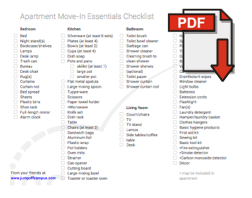
Whether this is the first time you’re moving off campus, or you’ve been living off campus, it always seems like you’re forgetting something when it comes to packing everything you’ll need.  Trust us:  We’ve been there.  That’s why we’ve come up with a checklist of things you’ll need when you start packing up.  We know, it looks like one heck of a list, but you just never know what you’ll forget.

Click here to download a PDF copy.

BEDROOM

  • Bed
  • Night stand(s)
  • Bookcase/shelves
  • Lamps
  • Desk lamp
  • Trash can
  • Bureau
  • Desk chair
  • Rug(s)
  • Curtains
  • Curtain rod
  • Bed spread
  • Sheets
  • Plastic bins
  • Shoe rack
  • Full-length mirror
  • Alarm clock

KITCHEN

  • Silverware (at least 8 sets)
  • Plates (at least 4)
  • Bowls (at least 2)
  • Cups (at least 4)
  • Wine glasses (for those 21+)
  • Dish soap
  • Pots and pans (at least 1 skillet, 1 large pot, and 1 smaller pot)
  • Flat metal spatula
  • Large mixing spoon
  • Tupperware
  • Scissors
  • Paper towel holder
  • Microwave (if the apartment doesn’t come with one already)
  • Knife set
  • Dish rack (for next to the sink when you’ve finished washing them)
  • Table
  • Chairs (at least 2)
  • Sandwich bags (you may want gallon size and smaller sizes)
  • Aluminum foil
  • Plastic wrap
  • Pot holders
  • Oven mits
  • Strainer
  • Can opener
  • Cutting board
  • Large mixing bowl
  • Toaster or toaster oven

BATHROOM

  • Toilet brush
  • Toilet bowl cleaner
  • Plunger
  • Garbage can
  • Shower cleaner
  • Cleaning brush to clean shower
  • Shower shelves (optional)
  • Toilet paper
  • Shower curtain
  • Shower curtain rod

LIVING ROOM

  • Couch/chairs (depending on how much space you have)
  • TV (optional)
  • TV stand (also optional)
  • Lamps
  • Side tables/coffee table
  • Desk (you may want to include one in case you want to work in the living room)

MISCELLANEOUS

  • Hand soap (for both bathroom and kitchen)
  • Sponges
  • Paper towels
  • Tissues
  • Garbage bags
  • Broom and dust pan
  • Vacuum
  • Carpet cleaner (for those nasty spills)
  • Disinfectant wipes
  • Window cleaner
  • Light bulbs
  • Batteries
  • Extension cords
  • Flashlight
  • Fan(s)
  • Laundry detergent
  • Hamper/laundry basket
  • Clothes hangers
  • Basic hygiene products
  • First aid kit
  • Sewing kit
  • Basic tool kit
  • Fire extinguisher (if your apartment doesn’t already have one)
  • Smoke detector (your landlord should provide one, but you should make sure it works properly when you first move in)
  • Carbon monoxide detector (your landlord should also provide one of these, but you should make sure it works properly when you first move in)
  • Décor (i.e. picture frames, posters, decorative pillows, etc.)
Standard